


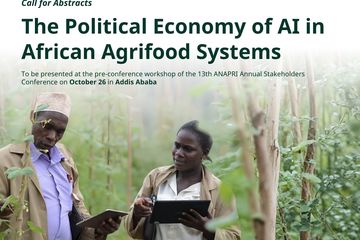
The Africa Network of Agricultural Policy Research Institutes (ANAPRI), in partnership with the International Food Policy Research Institute (IFPRI), and with support from the CGIAR Science Programme on Policy Innovations, and the Digital Transformation Accelerator, invites researchers, policymakers, practitioners, and development actors to submit abstracts for a pre-conference workshop on The Political Economy of AI in African Agrifood Systems. The workshop will be held on the margins of the 13th ANAPRI Annual Stakeholders Conference in Addis Ababa, Ethiopia, on 26 October 2026. ANAPRI and IFPRI are currently seeking funding for bursaries for travel and participation of delegates with selected abstract submissions.
Background and Rationale
Artificial intelligence (AI) is increasingly being positioned as a transformative force in African food, land, and water systems (FLWS). Through large scale data collection, predictive analytics and personalized advisory tools, AI is framed by many policymakers and tech companies as a solution to persistent challenges of food insecurity, climate vulnerability and public service delivery.
Yet these promises raise urgent questions. Who controls the data and infrastructures on which AI systems depend? How are digital tools being used to support policymaking, organize public life, and shape relations between citizens, states, markets, and development actors? And how are the benefits and risks of AI distributed across places already marked by unequal access to resources, political unrest, and limited technological capacity?
This call for abstracts invites contributions that critically examine the political economy of AI in FLWS. We are particularly interested in work that moves beyond either technological optimism or blanket critique, and instead investigates how AI is being imagined, institutionalized, contested, and made consequential in specific social, ecological, and political contexts. In doing so, the collection asks how policy research institutions can help governments navigate this rapidly shifting landscape, build regulatory and institutional capacity, and inform policy change that are grounded in the needs, priorities, and aspirations of smallholder farmers and other FLWS actors.
Workshop Objectives
The workshop aims to create a space for comparative learning on how AI is being governed, contested, and applied in FLWS. Rather than treating AI governance as a technical or universal policy challenge, the event will examine how lessons from different institutional, political, and infrastructural settings can inform more effective governance approaches in Africa. In addition to the presentation of new research, it will bring together researchers, policymakers, technology actors, civil society, and ANAPRI member institutions to identify what is already being learned from practice, where policy gaps remain, and how evidence can support national, regional, and continental strategies that are responsive to the needs of smallholder farmers and rural communities.
Thematic Areas
We welcome empirical, conceptual, methodological, and policy-oriented contributions addressing one or more of the following themes:
1. Data governance and digital infrastructure: who controls the means?
AI systems depend on data: who collects it, who owns it, who can access it, and who has the authority to interpret and act on it. In African food, land, and water systems, these questions are closely tied to histories of extraction, unreliable and inaccessible digital infrastructure, weak regulatory capacity, and fragmented institutional arrangements.
Abstracts under this theme may explore topics such as agricultural data governance, data sovereignty, digital public infrastructure, platformization, interoperability, cybersecurity, privacy, consent, and the role of public, private, and development actors in building and governing AI-ready data ecosystems.
2. AI and the organization of public life: who shapes decisions?
AI and other digital tools are increasingly being introduced into policy processes, public administration, agricultural extension, environmental monitoring, social protection, and other aspects of public life. These tools may support decision-making, improve coordination, or make public systems more responsive. At the same time, they may shift accountability, obscure political choices, or embed particular assumptions about efficiency, expertise, and development.
Abstracts under this theme may present, demonstrate, or assess AI-enabled tools for policy and public systems, while also critically examining their risks, limitations, and governance implications. We welcome contributions on decision-support systems, dashboards, predictive models, advisory platforms, monitoring systems, and other tools that raise questions of accountability, transparency, bias, exclusion, institutional dependency, and public value.
3. AI in the majority world: who benefits, and who bears the risks?
The development and deployment of AI in African FLWS is marked by unequal access to resources, political instability, limited technological capacity, and uneven institutional authority. These conditions shape who is able to benefit from AI-enabled systems, who bears their risks, and whose interests are reflected in emerging policy and regulatory frameworks.
Abstracts under this theme may examine how AI policies, investment decisions, data governance arrangements, and regulatory frameworks reduce or reinforce existing inequalities. We welcome contributions on the distributional consequences of AI for smallholder farmers, pastoralists, fishers, women, youth, rural communities, displaced populations, and other groups whose livelihoods depend on FLWS.
Who Should Submit?
This call welcomes interdisciplinary contributions from scholars and practitioners working across agriculture, economics, political science, data science, development studies, sociology, ICT policy, law, agronomy, and related fields. Submissions from African institutions, early-career researchers, women researchers, policymakers, farmer organisations, NGOs, and development practitioners are particularly encouraged. We also welcome contributions that present work on/from all majority world/Global South geographies that are relevant for sub-Saharan Africa.
Abstract Submission and Guidelines to Authors
Submission Deadline: 31 July 2026
Notification of Acceptance: 31 August 2026
Pre-Conference Workshop: 26 October 2026
13th ANAPRI Annual Stakeholders Conference: 27–29 October 2026
Guidelines for Submissions
Please review the guidelines before submitting.
Access the submission guidelines here.
https://www.anapri.net/call-for-abstracts-the-political-economy-of-ai-in-african-agrifood-systems/
