

Results for "society"
258 Results
Call for Thought Pieces Regarding Race and Ethnicity in Africa and the Diaspora
AAP is issuing a call for thought pieces from anywhere in the world that are short, critical reflections of issues around race and ethnicity in higher education institutions as well as other key stakeholder organizations in Africa and the African Diaspora.
The first deadline for thought piece summary (up to 500 words) is Oct. 30, 2021. Summaries must include title, text, author’s name and affiliation.
For the full call for contributions and submission details, visit the link below.
https://aap.isp.msu.edu/engage/aap-perspectives/
Read more

By: Raquel Acosta
Due Date: Oct, 30, 2021
Culture and society
+1
Leave a comment

No Preview Available
Souleymane Bachir Diagne in conversation with Wayne Modest, Aude Christel Mgba, and Ryan Skinner.
CONVERSATION | 9 Sept 2021 | 16.00-17.45 CET | Zoom online
As part of the Thinking With series, we invite Souleymane Bachir Diagne to discuss his work in conversation with Aude Christel Mgba and Ryan Skinner. In African Art as Philosophy: Senghor, Bergson and the Idea of Negritude (2011), Souleymane Bachir Diagne writes of Léopold Sédar Senghor’s lifelong project to think through “affirmation of the self [as] a natural reaction to colonial domination” (188): “Beyond affirming the aesthetic virtues revealed in pieces of art created by Africans, Senghor wished to stress the metaphysics they offered for reflection: along with the art through which it had been written, he wished to rescue a worldview, a feeling and a thinking that were also contributions to the humanism of tomorrow by African-being-in-the-world” (7-8).
“In our efforts at the Nationaal Museum van Wereldculturen to better honor and listen to the lives the ‘objects’ in our museums have led and wish to lead, we hope to better think more reciprocally in relationship to these objects and the communities invested in their being. We are compelled by Diagne’s work to think more deeply about the histories, afterlives, and temporalities in which our objects exist. How might we allow the objects to speak better from themselves, for themselves, while all the while honoring the complex positionalities of those who are enjoined to engage these objects? We understand those persons who are called upon to better honor the objects to be: those living in the places where the objects were obtained (gifted, seized, stolen); those who relate to African art from diasporic sensibilities; and those who are implicated by a colonial past as perpetrator and/or who benefit from systems of privilege, as per Michael Rothberg. Together, in Relation, and even thanks to the tensions implied by Glissantian Opacity, we hope to better be responsible to our work and engagement as professionals and visitors to our ethnographic museums.”
More about Zoom event: https://www.materialculture.nl/en/events/thinking-souleymane-bachir-diagne-african-art-phi...
Registration for Zoom event: https://us06web.zoom.us/webinar/register/WN_X6gKuBv3RVuw5FEGTCE6uw
Read more
By: Raquel Acosta
Due Date: Sep, 9, 2021
Culture and society
+1
Leave a comment
No Preview Available
Call for Abstracts: "Relations to Plants as a Heritage From Below in African Cities"
The deadline for submitting a paper for the panel "Relations to Plants as a Heritage From Below in African Cities" at the next African Studies Association of Africa (ASAA) conference, at the University of Cape Town (South Africa) from 11 to 16 April 2022, has been extended to 30 September. The submission of the paper proposal (max. 250 words) has to be done via this platform: https://2022conference.as-aa.org/submit-work/call-for-abstracts/
ASAA encourages paper presenters to reflect on the conference theme and address issues outlined in the theme description. With a massive number of abstracts submitted for presentations at ASAA conferences, the ASAA2022 Conference Committee is dedicated to guaranteeing a timely and fair review process with the international norms of double-blind peer review.
The decisions of the Scientific Committee will be communicated on 14th November 2021. ASAA early-bird registration will open on 1st November 2021. See eligibility criteria and learn about the application process in the link below!
Call for abstracts – ASAA2022 (as-aa.org)
For any queries with the above, please email: as-aa2022.org@uct.ac.za
Read more
By: Raquel Acosta
Due Date: Sep, 30, 2022
Culture and society
+1
Leave a comment
No Preview Available
British Ecological Society: Training & Travel Grants
Objectives
These grants help PhD students and postgraduate research assistants to meet the costs of specialist field training courses and to network and publicise their research by presenting their work at workshops and conferences.
Deadline
Our second round of funding for 2021 is now OPEN with a deadline of 17:00 (BST) Friday 10 September.
Training and Travel Grants are awarded on a first come, first serve basis, therefore once all of the funding has been allocated, we are no longer able to accept applications.
If the meeting you wish to attend is between January and the end of June, you must apply to the first round. If the meeting is after June, you should apply to the second round. (Please note that awards may take up to 2 weeks to be processed, therefore events taking place in the first two weeks of July are eligible for application within the first round).
To Apply
REGISTER ONLINE
When applications open, register/log in to our online grants system, complete your contact details, and navigate to ‘Your Applications’.
Virtual Events and Courses
Applicants can now use these grants to attend a virtual conference/course, to cover registration fees up to £250. In these circumstances, the applicant must provide proof of registration on acceptance, and meet the standard eligibility and criteria as outlined below. If you are unsure that your event meets the BES criteria, contact Siri McDonnell.
Eligibility and Conditions
All applicants are required to:
be a BES member.
have at least a B.Sc. or equivalent degree.
use an institutional email address in order to apply. Any exceptions must be discussed in advance of submission with Grants & Events Officer, Siri McDonnell for approval.
be a PhD student, postgraduate research assistant (within 3 years of completing relevant degree) or equivalent (Postdoc researchers are therefore not eligible to apply).
work or study at a university or research institution (including field centres, NGOs, museums, etc.) that provide research facilities.
work in scientific areas within our remit (the science of ecology) and of relevance to the training course or meeting they are applying to attend.
give a presentation if attending a meeting.
no retrospective claims for funding will be considered.
no applicant may receive more than two Training & Travel Grants in any five year period. There must be at least three years between grants.
There is no application deadline; instead, there are two opening dates within a 12 month period (January and July). Once funding for one round has been allocated, the round will close until the next opening date. If the meeting you wish to attend is between January and the end of June, you must apply to the first round. If the meeting is after June, you should apply to the second round. (Please note that awards may take up to 2 weeks to be processed, therefore events taking place in the first three weeks of July are eligible for the first round).
Our website will be updated when the funding for each round has been allocated.Our Training and Travel grants are awarded on a first come first serve basis; submitting an application does not guarantee funding.
If you want to attend an event/training that falls within our remit, please email our Grants & Events Officer, Siri McDonnell.
A maximum of two places per training course may be funded on a first come first serve basis. No more than two applicants from the same institution may attend the same meeting/conference.
The applicant is responsible for booking to attend the course/event/workshop and as the grants are paid in retrospect, must pay the relevant institution/organiser the required fee at the time of booking as well as all monies additional to the award amount i.e. single supplements.
Successful applicants are bound by the booking conditions of the organisation running the event, course or workshop and non-attendance on a booked course or event will result in the applicant being personally liable for the cancellation fee.
It is a condition of all of our grant schemes that applicants submit a report within three months of the end date of your award. Reports will be submitted via our online grants system.
Our Events
We offer significant student registration discount on the costs of our own events, including our symposia and majority of our Special Interest Group (SIG) events. Therefore, Travel Grants are not available for these meetings. Grants may be considered for SIG events if the meeting is taking place outside the country in which the applicant resides.
We have a limited number of grants available to attend our Annual Meeting and Symposia if you are a student, postgraduate research assistant, and a citizen of/working in a ‘low-income economy’ or ‘lower-middle-income economy’ country according to the World Bank categorization.
Annual Meeting
Deadline: Applications will open later in 2021.
We are pleased to be able to support a limited number of students/postgraduate research assistant who are a citizen of/ and working in a ‘low-income economy’ or ‘lower-middle-income economy’ country according to the World Bank categorization to attend our Annual Meeting each December. These will be awarded on a first come first serve basis. Grants of up to £1000 are available.
If you wish to apply for a Travel Grant to attend our Annual Meeting, please note the same conditions apply as the standard Training & Travel Grants (please see above). In summary you need to:
Be a student/postgraduate research assistant
Be a citizen of and working within a ‘low-income economy’ or ‘lower-middle-income economy’ country according to the World Bank categorization.
Have a talk or poster presentation accepted at the meeting
Be a member of the BES
This counts as a standard Training & Travel Grant, therefore the following applies: no applicant may receive more than two Training & Travel Grants in any five year period. There must be at least three years between grants.
Please note: applicants who are awarded a grant to cover registration fees for the Festival of Ecology 2020 will still be eligible to apply for all of BES Travel Grants in 2021, including those to our 2021 Annual Meeting.
When applications open, register/log in to our online grants system, complete your contact details, and navigate to ‘Your Applications’.
Value
Unless the applicant is self-funded, it is expected that their organisation will provide at least £150 of support towards the costs of the event.
a maximum of £250 is available to cover the cost of registration fees for virtual conferences/courses.
a maximum of £300 is available for events and courses being held in the applicants’ country of residence.
a maximum of £500 is available for events being held outside the applicants’ country of residence.
grants of up to £1,000 are available to attend our Annual Meeting if the applicant is a citizen of and working in a country that is classified as ‘low-income economy’ or ‘lower-middle-income economy’ according to the World Bank.
the grant will be paid after the event has taken place, on receipt of a brief report, certificate of attendance and any appropriate receipts.
all costs must be clearly justified within the budget section. Costs that are not justified will not be considered. Please ensure all costs are clearly calculated in GBP (British Sterling).
Learn more: https://www.britishecologicalsociety.org/funding/training-travel-grants/?utm_source=RUFORUM+Mailing+List&utm_campaign=d18db56afe-RUFORUM+Weekly+-+Vol.3+No.25_COPY_01&utm_medium=email&utm_term=0_1fcfbb8a0b-d18db56afe-346973753&ct=t()&goal=0_1fcfbb8a0b-d18db56afe-346973753&mc_cid=d18db56afe&mc_eid=d95cf18a8d
Read more
By: Madeleine Futter
Due Date: Sep, 10, 2021
Other
Leave a comment

The Ibrahim Leadership Fellowships
The Ibrahim Leadership Fellowships were established in 2011 to identify and mentor the future generation of outstanding African leaders. Each year three Fellows have an opportunity to work in the executive offices of the AfDB (Abidjan), ECA (Addis Ababa) or the ITC (Geneva), with a stipend of $100,000. During their 12-month programmes, Fellows gain both technical and leadership skills, while contributing directly to research and policy design. A special feature of the programme is the opportunity to benefit from the direct mentorship of the heads of the host organisations. Fellows also become members of the Now Generation Network (NGN), through which they continue to contribute their skills and insights to building a better Africa.
More information about the opportunity can be found on Mo Ibrahim Foundation website.
Read more
By: Derek Tobias
Due Date: Oct, 15, 2021
Culture and society
+1
Leave a comment
ASA 64th Annual Meeting: 2021 Call for Proposals
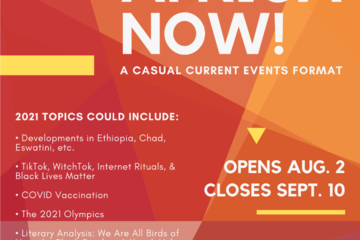
AfricaNow! Call for Proposals
The African Studies Association (ASA) is excited to continue our AfricaNow! format to accommodate emerging issues on our Annual Meeting program. These sessions will feature late-breaking issues that emerged subsequent to the close of the ASA CFP.
Format:Sessions can be proposed as group discussions (maximum of five presenters), individual presentations, or memorials. Please ensure that your AfricaNow! proposal meets the following criteria:• Proposals must relate directly to current events on Africa and/or African Studies.• All AfricaNow! organizers and presenters must register for the Annual Meeting when notified of acceptance.
Suggested Topics for 2021 are (but not limited to):• Developments in Ethiopia, Chad, Eswatini, South Africa, etc.• TikTok, WitchTok, Internet Rituals, & Black Lives Matter• COVID Vaccination• The 2021 Olympics• Literary Analysis: We Are All Birds of Uganda, Black Sunday: A Novel, Unbury Our Dead With Song, etc.• All 2021 Memorials
To Submit:Please prepare a (1) basic title, (2) an abstract that describes the session and confirms its timeliness, (3) the format, (4) the names and affiliations of each presenter, (5) the duration of the session, and (6) your preferred date and time. We will do our best to accommodate your preferences.
Submission GuidelinesAfricaNow! sessions will not be peer-reviewed and submissions of formal panels and papers will not be accepted in this format. The participation rules do not apply to AfricaNow! sessions. Presenters who are already on the program may submit proposals. Abstracts that were already submitted prior to the submission deadline cannot be resubmitted for AfricaNow! consideration. All requests for sessions will be reviewed by the ASA Secretariat for general appropriateness.
The AfricaNow! submission portal via OpenWater is currently open and will close September 10, 2021.
SUBMIT TO AFRICANOW! HERE.
Read more
By: Madeleine Futter
Due Date: Sep, 10, 2021
Culture and society
+1
Leave a comment

The Humanities and Arts Research Program (HARP) Development program
The Humanities and Arts Research Program (HARP) Development program provides funds to support faculty who are conducting important research leading to creative and performance projects or activities in the arts and humanities. This limited funding is designed to support faculty in the development of projects that seem likely to enhance the reputation of the faculty member and the university.
Within the Development program, there are two panels that conduct the reviews: the Humanities Research panel and the Exhibition and Performance panel. The Humanities Research panel will review applications that are supporting research projects and scholarship broadly related to the humanities. The Exhibition and Performance panel will review proposals that support scholarship and creative activities leading to an exhibit or performance. See the FAQs for clarification.
The deadline for HARP Development applications will be in early-October, with awards announced in February. Funding will be available for a two year period beginning on March 1.
What types of projects are eligible?
HARP development projects should:
produce results or a product that is likely to receive external recognition (e.g., through a publisher's interest or through available distribution or exhibition venues) or be used beyond MSU.
ultimately lead to a scholarly or creative product (e.g., book, CD, musical composition, play, artwork) with the potential for significant impact in the discipline or related areas.
Who is eligible?
Tenured and tenure-track faculty
Faculty with uninterrupted, multi-year, fixed term appointments
Faculty with one-year appointments who are able to obtain written confirmation from their department chair of pending appointment through the duration of the grant (letters from the chair should be uploaded as part of the project description)
Academic specialists in the continuing appointment system who have the majority of their effort in the research category
Part time faculty who 1) have had an appointment for two consecutive years prior to the date of their submission, 2) have a commitment from their department chair indicating that their appointment will continue through the duration of the granting period, and 3) have an appointment of at least 50% with MSU
Faculty from Arts and Letters, Communication Arts and Sciences, James Madison, Lyman Briggs, Music, Social Science, and the Residential College in the Arts and Humanities are eligible to apply for HARP funding.
NOTE: Faculty emeriti are not eligible to apply for HARP funding.
NOTE: Faculty rank and proximity to promotion and tenure decisions will not be considered in the evaluation of proposals. All applications will be evaluated on the merit of the work being proposed.
For more information or to apply, visit the MSU Research and Innovation website
Read more
By: Derek Tobias
Due Date: Oct, 7, 2021
Culture and society
+3
Leave a comment

Discretionary Funding Initiative (DFI)
The Discretionary Funding Initiative (DFI), funded by the Michigan State University Foundation, provides bridge funds for tenure stream faculty for additional studies needed for resubmission of an unsuccessful, but nearly fundable, grant application to the same program within a funding agency.
To request funding from this program, faculty should submit a proposal via the grant proposal system. Applicants will be expected to provide copies of their previous external reviews, if applicable, and describe the work that will be completed to address the comments provided in those documents. The research associate dean of the applicant's college (lead college if appointed in multiple colleges) will review applications, and submit a prioritized list to the Office for Research and Innovation (OR&I). Requests for support approved by the research associate deans will be reviewed by the OR&I.
The maximum award from OR&I will be $25K and will require a 100% (up to $25K) match from units or colleges. Funds will be available for 18 months.
For more information or to apply, click here.
Read more
By: Derek Tobias
Due Date: Sep, 9, 2021
Agri-food systems
+5
Leave a comment
No Preview Available
AAUW: International Fellowships
Funding: $18,000–$30,000Opens: August 1Deadline: November 15
International Fellowships have been in existence since 1917. The program provides support for women pursuing full-time graduate or postdoctoral study in the United States to women who are not U.S. citizens or permanent residents, and who intend to return to their home country to pursue a professional career. A limited number of awards are available for study outside of the U.S. (excluding the applicant’s home country) to women who are members of Graduate Women International (see the list of GWI affiliates). Both graduate and postgraduate studies at accredited U.S. institutions are supported.
Applicants must have earned the equivalent of a U.S. bachelor’s degree by the application deadline and must have applied to their proposed institutions of study by the time of the application. Recipients are selected for academic achievement and demonstrated commitment to women and girls.
Recipients return to their home countries to become leaders in business, government, academia, community activism, the arts or scientific fields.
For more information go to: https://www.aauw.org/resources/programs/fellowships-grants/current-opportunities/international/
Read more
By: Madeleine Futter
Due Date: Nov, 15, 2021
Culture and society
Leave a comment

CALL FOR PAPERS: Pan-African Symposium on Digital Learning in Global Africa
Thursday & Friday, October 21 & 22, 2021 | Virtual International Symposium
The Howard University Department of African Studies will host an international virtual symposium on Digital Learning in Global Africa During and After the COVID-19 Pandemic, on October 21 and 22, 2021. The Department plans the symposium in collaboration with the Title VI Center for African Studies at Howard University; the Howard University Department of World Languages and Cultures; the Howard University Department of Strategic, Legal and Management Communication; the Howard University Center for Women and Gender Studies; the Thabo Mbeki African School of Public & International Affairs (TM-School) South Africa; the Bowie State University Department of History & Government; Distance Education for Africa (DeAfrica); and the State of the African Diaspora.
The purpose of the Symposium is to enable scholars, researchers, and Higher Education Executives from the African continent and the Global African Diaspora (GAD) to critically reflect on the challenges and opportunities that the COVID-19 pandemic has created for higher learning and research on the continent of Africa, in the Caribbean, and in the African American community. It is also to enable the participants to explore concrete and innovative ways in which institutions in these Global African regions can utilize digital technology to meet the challenges and seek ways to improve teaching, learning, and research.
Paper Proposal Submission Deadline: July 15, 2021
Submit your paper via the Paper Submission Form and register via the Conference Registration Form below.
Read more
By: Madeleine Futter
Due Date: Jul, 15, 2021
Culture and society
Leave a comment
No Preview Available
PhD opportunity (France-Sudan)
PhD opportunity (France-Sudan): “A History of Women's Urban Popular Labour in Colonial Sudan (1900-1956)”
by Elena Vezzadini
Call for a PhD candidate on the theme
“A History of Women's Urban Popular Labour in Colonial Sudan (1900-1956)”
Presentation
A three-year PhD scholarship is offered to a candidate willing to develop the following theme: the social history of female popular professions in urban contexts during the Anglo-Egyptian Condominium in Sudan through the lenses of vernacular, oral and photographic sources.
In the historiography of contemporary northern Sudan, women’s history is conspicuous for its scarcity, and all the more the history of “ordinary women”, including one fundamental aspect of women’s lives, that is labour.
The absence of women in the historiography of northern Sudan (the actual Republic of Sudan), and especially during the colonial period, is often seen as the result of two intertwined factors: the absence of sources and the absence of women in the public space as a result of female seclusion. This goes hand in hand with another common assumption: that during colonization, most women who worked for a remuneration were either slaves and former slaves or came from regions that had been slave reservoirs during the 19th Century. Because of their status, they could engage in behaviours that were frowned upon by free women, such as publicly mixing with men in the workplace.
British official documents, located in the national archives in Khartoum and London, are indeed poor in information about Sudanese women, regardless of their status or social group. However, this is not the case for all archives and all types of sources. Indeed, a type of source that is rich in information about “ordinary women” are the photographs kept at the Sudan Archive in Durham University (UK), which hosts the largest collection of documents left by former colonial officers. The archive includes over 57,000 photographs, among which there are hundreds and probably thousands of images depicting women, most of them dating from the period between 1920 and 1950, and located in urban areas. Already at a first glance, this archive is fascinating and surprising, and seems to contradict the historiographic doxa. First, women occupied public –yet gendered– spaces: they had their own areas at the market and roamed the streets for attending their jobs. Second, the photographs demonstrate the existence and even the large diffusion of remunerated female labour.
However, photographs represent only a starting point for locating a web of other sources. First, oral sources: in some pictures of the collection, reference is made to the name of the women represented and the place in which they were located. In some cases, and probably for some professions more than others, it may be possible to trace the descendants or younger colleagues of the women photographed. Thus, the second crucial source for this project will be represented by oral accounts by female urban professionals and their families. Finally, oral sources and photographs will be cross-referenced with another type of largely underexploited source, i.e. the women's vernacular press in Arabic, which developed from the 1940s onwards. The intersection of these three types of materials will allow rich and complex perspectives on the history of women's work, even if probably fragmentary. Finally, far from elminating the issue of slavery and marginalisation, this project will seek to investigate the boundaries between free and slave status, question these categories, and better understand the connection between female labour and social hierarchies in colonial Sudan.
Practical conditions, qualifications and application process
The programme: CNRS “international PhD scholarship”, IMAF Paris and CEDEJ Khartoum
This PhD scholarship is part of a special scheme called “international PhD scholarships” granted by the French National Centre of Scientific Research (CNRS), and it rests on special conditions: the scholarship lasts for three years, during which the PhD applicant is required to spend six months in Paris and six months in Khartoum each year. In Paris, he/she will be based at the Institut des Mondes Africains (IMAF), site Condorcet, Aubervilliers (Paris), which is the largest centre for African Studies in France (www.imaf.cnrs.fr). In Khartoum, the candidate will be based at the CEDEJ Khartoum (Centre for social, legal and economic studies and documentation in Sudan), a research centre affiliated with the CNRS (https://cedejsudan.hypotheses.org/).
Finally, the candidate will be registered at the Doctoral school of the Ecole des Hautes Études en Sciences Sociales, Paris, and his/her diploma will be issued from this school.
Financial conditions:
The PhD candidate will have a three-year contract with the CNRS, a monthly brute pay of about € 2135 (roughly around € 1700, depending on taxation rate), and 45 days of annual leave. A small travel budget may be sought for in order to apply for archival research in Europe and the UK; however, this depends on the limited financial possibility of IMAF and may vary from one year to the next; the candidate is encouraged to apply for fieldwork financial support from other institutions as well.
Qualifications and required training:
MA in History, preferably on a theme connected to social and gender history.
Applicants with a double background in African History and in Middle Eastern Studies are welcome to apply.
As the PhD thesis should be written ideally in English or otherwise in French, the candidate must have excellent writing skills in one of the two languages.
For non-French candidates, a working knowledge of French and the ability to communicate in this language will be a great asset.
Finally, ideally, the candidate will have at least a basic knowledge of Arabic.
A final note:
At IMAF, we make all efforts to promote diversity, equality and inclusion amongst our staff and students. As such, we welcome applications from all backgrounds. Applicants from African institutions are welcome to apply; they should only be aware that the procedure to apply for a work and study visa in France is cumbersome and fails in many cases. Thus, we will have to prioritize applicants who may have facilities in obtaining a work permit in France and a travel visa to Sudan.
Application process:
In order to apply, please send no later than July 21st 2021:
your CV in English or French.
your Master thesis (if written in French, Spanish, Italian, English, Arabic, or any Nordic language); or otherwise, if written in another language, a 10-page summary in English.
your master diploma and any diploma who may support your application (language training etc.).
a 1 or 2-page cover letter in which you explain your motivation to research the proposed theme, in English or in French.
A reference letter
These documents must be sent to the following address:
elena.vezzadini@cnrs.fr
The successful candidate will be notified no later than August 15th.
Read more
By: Madeleine Futter
Due Date: Jul, 21, 2021
Culture and society
Leave a comment
No Preview Available
CfP: special journal issue (Matrix) on Warfare and Peacemaking among Matricultural Societies
by Linnéa Rowlatt
Volume 3, Issue 2 (Nov 2022)
Call for Papers
Deadline for Abstract Submission: 1 October 2021
Theme: Warfare and Peacemaking Among Matricultural Societies
The view that ‘War is a game for men’ has been declaimed with loud voices – yet the Kanienʼkehá꞉ka (Mohawk) people, who have been described as the most fierce warriors of eastern North America, have a strong matriculture where the Clan Mothers nominate, install, and remove male Chiefs. Up to six thousand Fon women, known as Mino or ‘our mothers', fought in the army of Dahomey until the early twentieth century. The matriarchal Minangkabau of Indonesia militarily resisted Dutch colonization for almost fifteen years and, over a century later, launched a guerilla-based civil war against the Sukarno government. Scythian warriors of the Ancient period were women as well as men, since horse-riding largely negates the advantages of upper body strength. Clearly, these matricultural societies have not been strangers to war and violence, whether defensive or offensive, and many more examples could be provided. At the same time, many scholars claim that matricultural societies are, by definition, cultures of peace.
What are the strategies, means, and types of warfare, in its broadest sense, in which a matricultural society might engage? What does the idea of peace mean and how is it achieved and/or strengthened? What are the means whereby matricultural societies resolve conflict (domestic or foreign) before it comes to violence, and what role do women and men play in those processes? Among matricultural societies, who makes the political decisions to engage in warfare, whether defensive or offensive? What have been the consequences of war for matricultures, including the enhancement or diminishment of status for women? We look for submissions which address these questions and others related to the topic.
Taking matriculture as a cultural system in the classical Geertzian sense of the term, this issue of Matrix will explore the institutions and customs around warfare and peacemaking among matricultural societies, including cultures where women go to war themselves (whether as warriors, soldiers, spies, or in another way), where women are central to peace-building traditions, where women exercise military authority over men (formally or informally), or exercise the political authority to declare war (and end it). We take it as a given that some cultures have a weakly defined matricultural system, while others, who have strong matricultural systems, express this strength in several ways – one of which is through designating women as authorities over or active participants in violent conflict or as builders of peace.
We invite articles which present, analyze, or contextualize historical or present-day warfare by or upon matricultures and any social institutions which are involved, as well as articles which deconstruct the meaning of war and peace among matricultural societies. We are interested in questions such as: What is the role for women in warfare when the the society/ies in conflict have a flourishing matricultural system? Do cultures with flourishing matricultures have unique means of achieving peace, or strengthening it? How do women contribute to the processes of warfare among matricultural societies? In what matricultures do women have the authority to declare war, to conduct warfare, or the freedom to become warriors if they so chose?
Possible presentations may include but are not limited to:
styles of warfare as conducted by matricultural societies
means of preventing conflict used by matricultural societies
meaning of peace to matricultural societies and methods of achieving and/or strengthening it
the meaning of warfare in matricultural societies
women warriors or soldiers, and/or women’s warrior societies, historical or contemporary
political authority as exercised by women in matricultures
social institutions of matricultures where women exercise military power
the role of women in strategies of engaging and/or disengaging with external conflicts
the role of women in strategies of conflict resolution
the status of men and their relationships to women in martial matricultures
Issue Editor: Linnéa Rowlatt (Network on Culture)
Please submit a 300-word abstract (max) to the Issue Editor or to the Editorial Collective of Matrix: A Journal for Matricultural Studies
Submission via email to: lrowlatt@networkonculture.ca or info@networkonculture.cawith the Subject line ‘Matrix Vol. 3 (2) Abstract Submission’.
Deadline for Abstract Submission: 1 October 2021
About Matrix
Matrix: A Journal for Matricultural Studies is an open access, peer-reviewed and refereed journal published by the International Network for Training, Education, and Research on Culture (Network on Culture), Canada. Matrix is published online on a biannual basis.
For many years, scholarship has explored the expression and role of women in culture from various perspectives such as kinship, economics, ritual, etc, but so far, the idea of approaching culture as a whole, taking the female world as primary, as a cultural system in Geertz’ classical sense of the term – a matriculture – has gone unnoticed. Some cultures have a weakly defined matricultural system; others have strong matricultural systems with various ramifications that may include, but are not limited to, matrilineal kinship, matrilocality, matriarchal governance features – all of which have serious consequences relative to the socio-cultural status of women, men, children, and the entire community of humans, animals, and the environment.
The main objective of Matrix is to provide a forum for those who are working from this theoretical stance. We encourage submissions from scholars, community members, and other knowledge keepers from around the world who are ready to take a new look at the ways in which people - women and men, historically and currently - have organized themselves into meaningful relationships; the myths, customs, and laws which support these relationships; and the ways in which researchers have documented and perhaps mis-labeled the matricultures they encounter.
For more information, visit our website:https://www.networkonculture.ca/activities/matrix.
Read more
By: Madeleine Futter
Due Date: Oct, 1, 2021
Culture and society

Leave a comment