

Results for "ai"
110 Results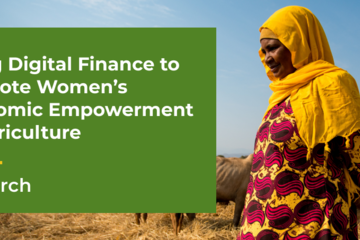
Using Digital Finance to Promote Women’s Economic Empowerment in Agriculture
Digital financial services have the potential to positively affect women’s economic empowerment, despite limitations that restrict their access to and use of financial resources and services. Building on the Digital Finance and Women’s Economic Empowerment in Beyond Production Roles in Agriculture and Food Systems report published by the Feed the Future Advancing Women’s Empowerment Program, this webinar will invite participants to learn about promoting women’s economic empowerment in agriculture using digital financial services.
Presenters will share out the findings, conclusions, and recommendations from the report, highlighting through a fireside chat the lessons learned and best practices from implementers and service providers working in the DFS space, and provide time for participants to pose questions to the presenters.
To learn more/Register: Using Digital Finance to Promote Women’s Economic Empowerment in Agriculture | Agrilinks
Read more

By: Raquel Acosta
Due Date: Mar, 30, 2022
Agri-food systems
Leave a comment
No Preview Available
Young African Landscape Leadership Program
Do you have a demonstrated commitment to advancing sustainability for Africa’s landscapes, seascapes and communities?Do you want to be part of a global community of friends working to promote sustainable and equitable land management through the landscapes approach?Are you between 18 and 35 years old?The Global Landscapes Forum (GLF), in partnership with the Youth in Landscapes Initiative (YIL), is launching the first ever “Young African Landscape Leadership” program, an 8-months program filled with networking meetings, regional dialogues, workshops and more.Let us know who you are, and your motivation to join.
With a median age of just 19.7 years, Africa’s diverse population is by far the youngest of any other continent in the world. These unique demographics offer a significant advantage in the drive to revive ecosystems and safeguard livelihoods. Africa’s youth have immense potential to forge a new development model and vision for the continent as they are already champions for landscape action and community-based solutions.
The GLF, in partnership with the Youth in Landscapes Initiative, is launching the first ever Young African Landscape Leadership, an eight-month annual program filled with networking meetings, regional dialogues, workshops and much more.
Learn more/apply:
Young African Landscape Leadership 2022 - Youth in Landscapes Initiative (globallandscapesforum.org)
Read more
By: Raquel Acosta
Due Date: Mar, 31, 2022
Culture and society
+1
Leave a comment
No Preview Available
Young African Leaders Programme
The Young African Leadership Programme funded by the European Commission is a tailor-made fellowship and training programme aiming at catalysing and fostering changes as envisioned in the Africa Agenda 2063 and in the Africa-EU Partnership. After a pilot cohort in Autumn 2021, the second cohort of Young African Leaders is expected in Florence in September 2022
The Young African Leaders Programme is a fellowship scheme that provides a unique opportunity for policy experts from Africa (all regions) to further develop their policy work and professional and leadership skills amidst international experts.
Furthermore, the Programme aims at creating new networks, connecting a strong cohort of leaders committed to driving change in their own countries and across the continent, as well as address the gender gaps and foster inclusivity in leadership roles.
In the dynamic academic environment of the European University Institute (EUI) in Florence, selected participants will take part in workshops, training and skills development sessions, conferences, and study visits in Europe. Interaction with the other fellows, policymakers and the academic community at the EUI will make this a truly unforgettable experience.
The structure of the Programme will be as follows:
Executive Training Seminars on thematic issues;
Professional Development Workshops, providing a set of leadership skills, tools and concrete case studies;
Study Visits to EU institutions, relevant academia, and international organisations
Final individual written assignment
Award of the YALP certificate of attendance
Connection to network of scholars and practitioners knowledgeable in relevant transnational governance
The three-month leadership programme takes place from the 1 September 2022 to the 30 November 2022. Fellowships are fully-funded with a grant of € 2,500 per month. The selected African fellows must live in the area of Florence for the duration of their stay. The language of the Programme is English. Where possible, the STG will seek to integrate French. The Programme has an intensive training schedule, and is therefore a full-time and fully-funded fellowship scheme.
Who should apply?
The Programme targets mid-career, high potential policy-makers, diplomats, and professionals from Africa, working in national and local authorities, regional, continental, international organisations and development partners, civil society organisations, academia, media and private sector, in Africa. More precisely, the Programme is open to professionals (M/F/X), mid-career and executives alike, who are nationals of African countries, residing in Africa and are up to the age of 35.
This Programme is supported by the European Commission, Directorate-General for International Partnerships. This Call for applications is launched under a suspension clause, related to the final approval of the financing decision of the Programme by the European Commission. According to such clause, should not the financing decision be taken, the EUI/STG reserve the right to cancel the call without any prejudice to the Institute and potential beneficiaries.
This programme is supported by the Directorate-General for International Partnerships of the European Commission.
For enquiries about applications please vist: Young African Leaders Programme • European University Institute (eui.eu)
Or contact: apply.fellowships.stg@eui.eu
Read more
By: Raquel Acosta
Due Date: Jul, 4, 2022
Culture and society
+1
Leave a comment
No Preview Available
PILAF SKILL DEVELOPMENT IN STATA TRAINING
Stata is a complete and integrated data management software. It is fast, accurate, easy to use and provides all that can be considered as data science needs including data manipulation, visualization, statistics and automated reporting.
Date: March 23rd to June 15th 2022 (every Wednesday).
Time: 5:00pm – 7:00pm WAT.
Mode of delivery: ZOOM
Certificates shall be offered based on request and satisfactory level of participation during training.
Who can participate:
Academics
Researchers
Students (Undergraduates & Postgraduates)
Data Analysts & Scientists
Civil Servants
Entrepreneurs
Download training module here:
PILAF STATA TRAINING MODULE
FACILITATORS
Prof. O.E. Olubusoye
Dr. O.A. Otekunrin
Registration closes 17th March, 2022. Register at PiLAF STATA Training Registration Form (google.com)
Read more
By: Raquel Acosta
Due Date: Mar, 17, 2022
Education
Leave a comment
No Preview Available
Zoom based free SAWBO/Kataru network training: Scaling of impact through WhatsApp
This two-day ICT training will be held in two sessions. The first will be Monday, March 28 from 9:00 – 10:00 AM (Eastern Time/US). The second session will be Tuesday, March 29 from 9:00 – 10:00 AM (Eastern Time/US). In order to complete this training, attendance is required on both days.Kindly use this link to compare time zones https://timezonewizard.com/?gclid=Cj0KCQjwz7uRBhDRARIsAFqjulkIzMc5eqvDZToeBekhc0cNy_zVpO9BUAdagZRUeb2QM-egXUTj4ocaAoUGEALw_wcB Certificates will be presented to all attendees who complete the two-day training.Training will be held through Zoom and is accessible through your computer. Click https://zoom.us/ to download Zoom to your computer.Registration will be limited to 20 participants. Please ensure you are able to commit to attending both days of the training before you register.Please click the SUBMIT button at the bottom of the registration form linked here: Zoom based free SAWBO/Kataru network training: Scaling of impact through WhatsApp - March 28 and March 29, at 9:00 AM EST/USA (google.com) to complete your registration. Your spot in the training will not be reserved unless the SUBMIT button is clicked.Kindly send any questions about this form to Severina Adames at seveadames@sawbo-animations.org.
Read more
By: Raquel Acosta
Due Date: Mar, 28, 2022
Culture and society
+1
Leave a comment

East African Regionalism in Uncertain Times: Historical Legacies, Contemporary Challenges
Since its re-establishment in 2000, the East African Community’s (EAC) integration and cooperation agenda has made significant strides over the previous two decades. However, in recent years, this progress has come up against a series of political challenges including a fragmented response to the Covid-19 pandemic, tensions between national governments, border closures, the endurance of non-tariff barriers and rising economic protectionism. Although some have drawn parallels between these trends and those that led to the collapse of the first EAC in 1977, there are reasons to not be overly fatalistic about the future prospects of regional integration East Africa. For one thing, intra-EAC trade has grown significantly over the last twenty years, creating economic linkages across the region and an imperative to retain (if not strengthen) the regional integration process. Moreover, while the ‘high-politics’ of the EAC has recently been defined by division, it is important not to lose sight of the fact that the ideals of regional cooperation continue to endure outside of official summits and directives.
This conference aims to bring together academics, policymakers and stakeholders to take stock of the opportunities and enduring challenges facing the contemporary EAC integration agenda. In doing so, the conference will aim to take stock of the historical legacies of regional integration in East Africa, examining how the idea and practice of regionalism has evolved over time. It will also bring together experts and practitioners to offer insights into the future prospects and trajectory of the EAC.
We are inviting paper abstracts for this conference in themes such as:
The history of regionalism in East Africa – what are the continuities and changes between different periods of regional integration?
The ideologies and ideas that sustain the East African regional integration project
Cultural expressions of East African identity
Regionalism and development in East Africa
Participatory regionalism in East Africa – to what extent is the EAC’s regional integration agenda ‘people-centred’ and ‘private-sector’ driven?
The EAC and continental integration initiatives (i.e. AfCFTA)
Comparative regionalism – how does East African integration compare to other integration projects in Africa and across the world?
The deadline to submit abstracts of up to 250 words is the 1st April 2022. The conference will be hosted by the British Institute in Eastern Africa (BIEA) in Nairobi, Kenya. It is hoped that the event will run in a hybrid format that will allow participants to attend either in person, at the BIEA, or online. Please note, however, due to potential disruption from Covid-19, the event may have to be moved to an online only format.
Abstracts and general queries should be sent to: east.african.regionalism2022@gmail.com
Contact Info:
Dr. Chris Vaughan and Dr. Peter O'Reilly
School of Humanites and Social Sciences
Liverpool John Moores University
Contact Email:
east.african.regionalism2022@gmail.com
Read more
By: Raquel Acosta
Due Date: Apr, 1, 2022
Culture and society
Leave a comment
No Preview Available
U.S. Mission in Uganda Public Affairs Annual Program Statement
The U.S. Mission in Uganda’s Public Affairs Office is pleased to announce that funding is available through the Public Diplomacy Grant Program for projects ranging in value from $5,000 to $40,000. Projects for greater values will be considered on a case-by-case basis.
Grants are intended for committed and organized civil-society organizations, local representatives of civil society, think tanks, non-governmental organizations, cultural institutions, and academic institutions. Awards to individuals will also be considered on a case-by-case basis. All grantees must have a non-profit status.
Notice: For Fiscal Year 2022 all proposals submitted in response to this Annual Program Statement must include a contingency plan describing how the proposed activity would be implemented in the event that COVID-19 related health restrictions are in place during the anticipated period of performance.
Objectives and Project Outcomes:
The objectives of the Public Diplomacy Grant Program are to promote positive relations between the people of Uganda and the United States; reinforce shared values; and connect high potential Ugandan youth and young professionals (aged 16 to 35) as well as established professional leaders to the American people through projects that:
Help Ugandan youth aged 16 – 35, especially young women, explore and discover their potential through innovative science, technology, engineering, and math (STEM) programs, as well as entrepreneurship programs.
Encourage Ugandan youth aged 16 – 35 to participate in civic life through social entrepreneurship, volunteerism, and community engagement.
Strengthen understanding of U.S. values and institutions; highlight U.S. culture, including American Studies; and support diversity, inclusion, and equality.
Utilize the power of the arts to promote positive self-expression, social change, and economic opportunity among Ugandan youth aged 16 – 35.
Equip emerging community leaders (e.g., sports coaches, arts instructors, and cultural professionals) aged 22 – 35 with the skills and knowledge necessary to grow their organizations or to enhance their engagement with youth audiences.
Promote the development and application of new technologies and innovative solutions to economic, environmental, and social challenges. Projects could connect U.S. technology or public policy experts with Ugandan peers or foster the application of American technology and innovations to address challenges in Ugandan communities.
Support civil society organizations (CSOs) in developing a vibrant and prosperous democratic society through programs that strengthen NGO management, enhance the skills of early to mid-career NGO/CSO professionals, strengthen networks between NGO/CSO professionals in the United States and Uganda, or demonstrate to the public the positive role CSOs play in advancing a prosperous, healthy, and informed society.
To learn more: https://www.grants.gov/web/grants/view-opportunity.html?oppId=336894
Read more
By: Raquel Acosta
Due Date: May, 30, 2022
Culture and society
+1
Leave a comment
No Preview Available
AGRILINKS EVENT: Managing Soils to Address Global Challenges
Join us for the 2022 USAID Bureau for Resilience and Food Security (USAID/RFS) Research Honorary Lecture, given by 2020 World Food Prize Laureate Rattan Lal. Dr. Lal is recognized globally as a pioneer in soil-centric agricultural management to improve food security and develop climate-resilient agriculture through soil carbon sequestration, sustainable intensification, use efficiency of agroecosystems, sustainable management of soils, and soil health. His career in soil science and international agricultural research spans over 5 decades and four continents.
The lecture and discussion will outline global challenges including food and nutritional insecurity, climate change, soil degradation, water scarcity, and pollution. This presentation will also highlight Dr. Lal’s modeling research for achieving sustainable and resilient production systems to restore soil health. The strategy involves producing more from less and returning land back to nature.
To register: https://primetime.bluejeans.com/a2m/register/sgghvjcz
Read more
By: Raquel Acosta
Due Date: Feb, 24, 2022
Agri-food systems
+1
Leave a comment
Legume Systems Grant Writers Workshop and Seed Grant Competition
The USAID Feed the Future Legume Systems Innovation Lab at Michigan State University is pleased to announce the Legume Systems Grant Writers Workshop and Seed Grant Competition.
This unique opportunity will combine a grant writing workshop followed by a proposal writing competition. A total of six seed grants ($5,000 each) will be rewarded for research in any aspect of the legume value chin specific to cowpea, pigeon pea, or common bean for work in any of the following countries: Benin, Burkina Faso, Ghana, Malawi, Mali, Mozambique, Nigeria, Nigeria, Senegal, and Zambia. Application and concept note deadline is February 28, 2022. The goal of this event is to build the grant writing and science communication skills of partner country researchers.
See attached flyer for more details.
Read more
By: Raquel Acosta
Due Date: Feb, 28, 2022
Agri-food systems
Leave a comment
U.S. Mission in Uganda Public Affairs Annual Program Statement
The U.S. Mission in Uganda’s Public Affairs Office is pleased to announce that funding is available through the Public Diplomacy Grant Program for projects ranging in value from $5,000 to $40,000. Projects for greater values will be considered on a case-by-case basis.
Grants are intended for committed and organized civil-society organizations, local representatives of civil society, think tanks, non-governmental organizations, cultural institutions, and academic institutions. Awards to individuals will also be considered on a case-by-case basis. All grantees must have a non-profit status.
Notice: For Fiscal Year 2022 all proposals submitted in response to this Annual Program Statement must include a contingency plan describing how the proposed activity would be implemented in the event that COVID-19 related health restrictions are in place during the anticipated period of performance.
Objectives and Project Outcomes:
The objectives of the Public Diplomacy Grant Program are to promote positive relations between the people of Uganda and the United States; reinforce shared values; and connect high potential Ugandan youth and young professionals (aged 16 to 35) as well as established professional leaders to the American people through projects that:
Help Ugandan youth aged 16 – 35, especially young women, explore and discover their potential through innovative science, technology, engineering, and math (STEM) programs, as well as entrepreneurship programs.
Encourage Ugandan youth aged 16 – 35 to participate in civic life through social entrepreneurship, volunteerism, and community engagement.
Strengthen understanding of U.S. values and institutions; highlight U.S. culture, including American Studies; and support diversity, inclusion, and equality.
Utilize the power of the arts to promote positive self-expression, social change, and economic opportunity among Ugandan youth aged 16 – 35.
Equip emerging community leaders (e.g., sports coaches, arts instructors, and cultural professionals) aged 22 – 35 with the skills and knowledge necessary to grow their organizations or to enhance their engagement with youth audiences.
Promote the development and application of new technologies and innovative solutions to economic, environmental, and social challenges. Projects could connect U.S. technology or public policy experts with Ugandan peers or foster the application of American technology and innovations to address challenges in Ugandan communities.
Support civil society organizations (CSOs) in developing a vibrant and prosperous democratic society through programs that strengthen NGO management, enhance the skills of early to mid-career NGO/CSO professionals, strengthen networks between NGO/CSO professionals in the United States and Uganda, or demonstrate to the public the positive role CSOs play in advancing a prosperous, healthy, and informed society.
U.S. Content
In order to be eligible for funding consideration, proposals must demonstrate significant U.S. content. U.S. content can include, for example, the substantial participation of U.S. experts or alumni of U.S. government exchange programs, partnership with U.S. organizations or educational institutions, the involvement of U.S. companies present in Uganda, the application or adaptation of U.S. models and best practices, or learning materials related to American history, society, culture, government, or institutions. Initiatives that promote sustained cooperation between the people of the United States and Uganda even after program funding has concluded are encouraged. Proposals without significant U.S. content will not be considered for funding.
Activities that are typically funded include, but are not limited to:
Programs that reinforce and amplify lessons learned by alumni of State Department-funded exchange programs (both American and Ugandan alumni);
Youth engagement and leadership programs;
Workshops, seminars, trainings, and master classes on American themes or issues of mutual interest mentioned in the above goals of the Program;
Programs to empower young women;
Radio, television, and social media training and programming in support of the above program objectives;
Programs designed as a partnership between a Ugandan and U.S. organization;
Initiatives in support of the above program objectives that make creative use of the Mission’s American Center in Kampala or Nile Explorer bus, a mobile classroom that provides extracurricular learning opportunities in STEM and other subjects through visits to underserved communities across Uganda.
Activities that are not typically funded include, but are not limited to:
Social welfare, community development, or vocational skilling projects,
Fees and travel costs to attend conferences in the United States,
Ongoing salary costs and office equipment,
Paying to complete activities begun with other funds,
Projects that are inherently political in nature or that contain the appearance of partisanship/support to individual or single party electoral campaigns,
Political party activities,
Projects that support specific religious activities,
Trade activities; fundraising campaigns; commercial projects; scientific research; construction projects; or projects whose primary aim is the institutional development of the organization itself.
For more information or to apply, please visit grants.gov
Read more
By: Derek Tobias
Due Date: May, 30, 2022
Youth empowerment
+1
Leave a comment
English Access Microscholarship Program - Kenya
The US Embassy Nairobi invites interested applicants to submit proposals from implementing partners for 2022 -2023 English Access Microscholarship Program (Access) in response to the reference Notice of Funding Announcement (NOFO). Due to the uncertain situation with the COVID19 pandemic in Kenya, the Program might be delayed or postponed. There might also be restrictions in numbers of people who can attend public gatherings, travels and curfews hours, which might affect the implementation of the program. In this regard the submitted proposal should have an innovative component to engage Access students both in person and virtually. For virtual programs, proposals should offer creative ideas for remote/online content delivery, online/virtual promotional activities, and virtual participant/audience follow-up.
Background Information
The English Access Microscholarship Program (Access) is a global program supported by the U.S Department of State. Access provides highly motivated economically disadvantaged youth with an opportunity to learn English language skills and enhance leadership through teaching the basics of American culture and values of democratic development and civic engagement. It gives participants skills that may lead to better jobs and educational prospects. The program targets 13 – 20 year old students from underprivileged families to participate in afterschool instructions and intensive sessions. Since its inception in 2004, approximately 198,408 students in more than 95 countries have participated in the Access Program. In Kenya, there are more than 780 Access alumni, many of who are studying at, or have graduated from, top-tier universities throughout the country. The Access program must provide two years of English study, consisting of at least 180 hours of instruction per year.
The goal of the Access Program is to equip bright, talented, economically deserving students with a range of global citizenship skills anchored by the core components of enhanced English language skills and a stronger Kenyan-U.S. cross-cultural understanding. The global citizenship skills aim to build individuals with stronger self-esteem and a keen sense of public service in an increasingly globalized world. Global citizenship skills include, but are not limited to, critical and creative thinking, leadership, information technology, civic outreach, and media literacy. Participants should commit to enroll in classes during the full two year program. Selected participants must be bright, economically-disadvantaged secondary school students with a beginning level of English, ideally in Form 2 at the beginning of the program in January 2022. Students will graduate with certificates of completion from the U.S. Embassy Nairobi at the end of their two-year program.
PROGRAM DESCRIPTION
The Public Diplomacy Section of the U.S. Embassy in Nairobi announces an open competition to equip bright, talented, economically deserving students to learn English, develop civic engagement and leadership skills and gain multicultural awareness through teaching the basis of American culture and vales. Project-based and task-based approaches should be employed in order to help learners to understand and work on authentic local and global challenges. The English language component should break from traditional models to deliver a more meaningful, interactive language learning experience centered on the learner. Project-based and experiential approaches should be employed in order to help the learner use English to understand, discuss, and resolve authentic local and global challenges. Enhancement and off-site immersion activities should help extend the language learning experience beyond the classroom walls. Access classrooms should serve as strong educational models for a community. Programs should, where possible, aim at sharing new and relevant practices with English teachers in other schools, especially those from which the Access students are chosen. Other members of the community, including interested administrators, content teachers, and future educators studying at nearby universities, can also be included in outreach efforts. The participants’ parents should also be made aware of what and how the students are learning, and appraised of what they can do at home to encourage their children to learn more effectively. Civic outreach activities should further cement the connection between the Access program and community.
Providers can submit proposals of varying size with a minimum of $50,000 USD and a maximum of $175,000 USD, depending on the Provider’s capability, infrastructure, and geographic spread. The grantee should work with students in Mombasa and/or Isiolo Counties.
The project supports the Embassy’s strategic goal of sustaining Kenyan economy to achieve rapid economic growth. Program proposals should include using U.S. exchange program alumni, and the target region is Mombasa and/or Isiolo Counties. Ideal partners include Educational Institutions, non-profit organizations that use innovative methods to reach to economically disadvantaged youths in this region.
U.S. Embassy Nairobi reserves the right to split the project between two or more providers and may request providers to adjust their final proposals and budgets as necessary. All possible costs – instruction, books/materials, transportation, enhancement activities, administration, food and possible accommodation for intensive sessions – should be covered.
For more information about this opportunity or to apply, please visit grants.gov
Read more
By: Derek Tobias
Due Date: Dec, 8, 2021
Education
Leave a comment

Expressions of Interest: Training and Evaluation Datasets for African Languages
The purpose of this call for EOI is to identify projects to submit full proposals to develop open and accessible datasets for machine learning applications that will enable natural language processing for languages in sub-Saharan Africa. The ability to communicate and be understood in one’s own language is fundamental to digital and societal inclusion. Natural language processing techniques have enabled critical AI applications that facilitate digital inclusion and improvements in numerous fields, including: education, finance, healthcare, agriculture, communication, and disaster response, among others. Many advances in both fundamental and applied NLP have stemmed from openly licensed and publicly available datasets.However, such open, publicly available datasets are scarce to non-existent for many African languages, and this means the benefits of NLP are not accessible to speakers of these languages. Where relevant datasets do exist, they are often based on religious, missionary, or judiciary texts, leading to outmoded language and bias. There is a need for openly accessible text, speech, and other datasets to facilitate breakthroughs based on NLP technologies for African languages.Lacuna Fund seeks Expressions of Interest (EOIs) from qualified organizations to develop open and accessible training and evaluation datasets for ML applications for NLP in sub-Saharan Africa. The TAP recognizes the importance of datasets that would create significant impact regardless of the number of speakers of the included language, as well as the need for multi-lingual datasets.EOIs may include, but not limited to:
Collecting and/or annotating new data;
Annotating or releasing existing data;
Augmentation of existing datasets in all areas to decrease bias (such as gender bias or other types of bias or discrimination) or increase the usability of NLP technology in low- and middle-income contexts;
Creating small, higher-quality benchmark data for NLP tasks in low-resource African languages.
While the focus of Lacuna Fund is primarily on dataset creation, annotation, augmentation, and maintenance, proposals may include the development of a baseline model to ensure the quality of the funded dataset and/or to facilitate the use of dataset for socially beneficial applications.
For more information about the opportunity, click here
Read more
By: Derek Tobias
Due Date: Dec, 3, 2021
Culture and society
+1

Leave a comment