


Results for "history"
31 Results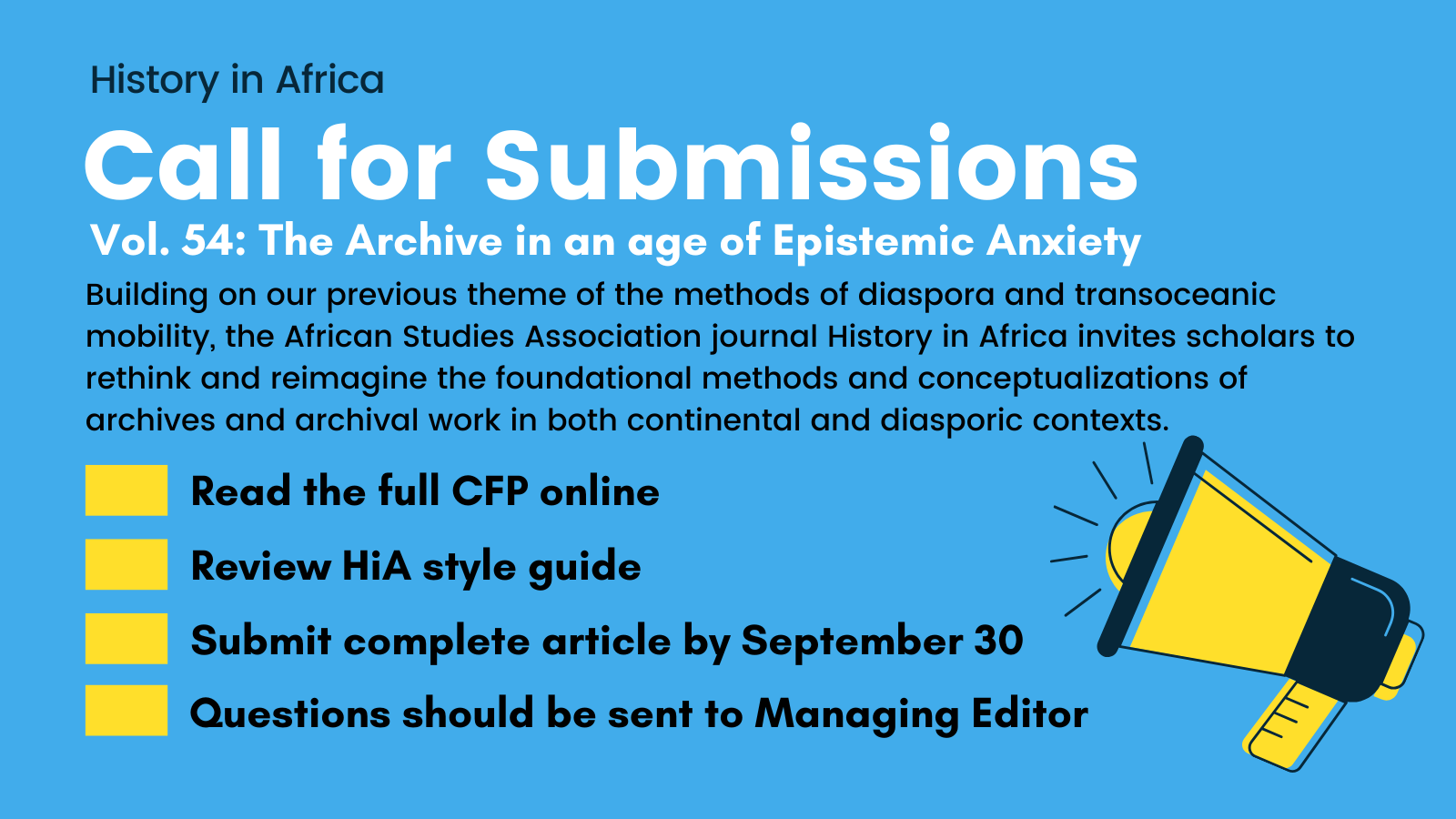
No Preview Available
Submit to HiA's Vol 54 CFP!
The History in Africa editorial team is seeking submissions for the upcoming volume. Articles selected for publication will be included in the 2027 volume of History in Africa. The Archive in an age of Epistemic Anxiety:Building on our previous theme of the methods of diaspora and transoceanic mobility, the African Studies Association journal History in Africa invites scholars to rethink and reimagine the foundational methods and conceptualizations of archives and archival work in both continental and diasporic contexts. Read the full call and submission guidelines online.
As always, submissions that fall outside the scope of this call are welcome by the deadline and throughout the year.
We welcome single authored and collaborative scholarship from senior scholars and emerging scholars alike.Review the journal style guide and submit by September 30, 2026.
Read more

By: Baboki Gaolaolwe-Major
Due Date: Sep, 30, 2026
Education
Leave a comment

Call for contributions: Workshop: The Theft of Art? Art Theories in Light of Global Art History
Call for contributions: Workshop: The Theft of Art? Art Theories in Light of Global Art History
(University of Strasbourg, 8 January 2027)
Building on Jack Goody’s (2007) highly influential thesis of The Theft of History, this workshop aims to address an “institution” that this critique of the Eurocentric historiographical model imposed on “the rest of the world” left largely unaddressed: the institution of art. By asking why art has escaped this ambitious and coherent theory in terms of its self-reflexivity and decentring, the workshop intends to put forward the hypothesis of a theft of art in the sense of a process of conceptual capture through which the authoritative, hegemonic, European theorising and historicising doxa has normalised its own, situated, artistic experience while obscuring its minority, or “provincial”, status, thus “stealing” the plurality of artistic concepts, terminologies, languages, and narratives produced by other cultures. Despite its heuristic value, Goody’s theft thesis, along with his work on the image—particularly his theory of the cognitive contradiction caused by representation (Goody, 1997; Chevalier & Mayor, 2009)—paradoxically appears to be a case in point of the cognitive contradictions embedded in discourses on art that purport to be self-reflexive and decentred, yet which perpetuate Eurocentric, asymmetrical and hierarchical frames of reference and teleological narratives. This workshop proposes to scrutinise this paradox.
Read more
By: Baboki Gaolaolwe-Major
Due Date: Jul, 17, 2026
Education
Leave a comment
No Preview Available
Call for Papers + Conference Opportunity | "Teaching World History in the Postmodern Classroom"
Opportunity Summary
World History Bulletin (World History Association) is seeking submissions for a special issue on Teaching World History in the Postmodern Classroom. The issue explores how world history education can foster empathy, critical thinking, civil discourse, and global understanding while helping students engage with diverse perspectives and complex historical and contemporary issues.
Suggested Topics
Historical empathy and perspective-taking
Critical thinking and evaluating historical evidence
Civil discourse and difficult conversations
Storytelling and historical understanding
Global connections and contemporary relevance
Public history and community engagement
Preparing students for global citizenship
Submission Types
Research articles
Pedagogical essays
Classroom case studies
Curriculum projects
Reflective practitioner essays
Public history and community-engaged learning initiatives
Conference Opportunity
Authors are encouraged to present at the 2026 H-Net Teaching Conference (August 17–20, 2026, virtual). Accepted conference presenters will receive first consideration for inclusion in the special issue.
Deadlines
H-Net Conference Abstracts
Deadline: July 1, 2026
Requirements:
200-word abstract
Brief CV
Contact: Heather Brothers (brothe10@msu.edu)
Special Issue Submissions
Deadline: September 15, 2026
Requirements:
Articles: 1,500–6,000 words
Chicago Manual of Style (18th ed.)
Endnotes, American English, 11-point Garamond
Contact
Joseph M. SnyderEditor-in-Chief, World History Bulletinjmsnyder@semo.edu
Website: https://www.thewha.org/world-history-bulletin
Read more
By: Yasmine Ben Slimane
Due Date: Jul, 1, 2026
Education
+1
Leave a comment
Business History Special Issue – Call for Papers
Theme
Indigenous Entrepreneurship under Colonialism and Beyond:Institutional Negotiation, Exclusion and Resilience
Looking for papers on
Indigenous entrepreneurship
Colonialism
Business history
Consumer culture
Markets
Institutions
Entrepreneurship
Timeline:
Informal enquiries welcome: June-September 2026
Abstract / proposal deadline (800–1,000 words)
1 October 2026
Decisions on abstracts
1 November 2026
Paper-development workshop(s)
Newcastle Business School, Northumbria University
Full paper submission deadline
1 May 2027
First-round peer-review decisions
September 2027
Revised paper deadline
1 February 2028
Final revision deadline
1 May 2028
Final acceptance target
June 2028
Expected online publication and launch
Autumn 2028
Expected print publication
Early to mid-2029
Submission Requirements: Authors are invited to submit an extended abstract or proposal for initial consideration. Submissions should be approximately 800–1,000 words and clearly set out the article’s research question, historical scope (including timeframe and location), sources and methodology, and anticipated contribution to the literature. Please also provide a tentative title, author name(s), affiliation(s), and contact information.
Proposals should be sent by 1 October 2026 to himadri@xlri.ac.in, with the other editors copied in: marktadajewski@gmail.com, andrew.perchard@otago.ac.nz, and zpittaki001@dundee.ac.uk. The email subject line should read: “CFP – Indigenous Entrepreneurship under Colonialism and Beyond Special Issue.”
Formatting and Length: Final papers should adhere to Business History guidelines (typically in the range of 8,000–10,000 words, including notes and references). Authors will be provided detailed instructions for manuscript preparation upon acceptance of proposals. We welcome informal inquiries if you have questions about the fit of a topic or the preparation of your proposal. All articles will be submitted through the Submission Portal for the journal in order to be peer-reviewed before acceptance for publication.
Read more
By: Yasmine Ben Slimane
Due Date: Oct, 1, 2026
Culture and society
+1
Leave a comment

Journal of the History of Ideas Graduate Student Symposium 2026
Theme
"Prophecy, Prediction, and the Politics of Futurity"
What it is
A graduate-student-only symposium where accepted participants present article-length papers and receive feedback from editors.
Format
Virtual (Zoom)
October 17, 2026
Eligibility
Graduate students at any stage.
Benefits
Present your work
Receive editorial feedback
Network with scholars
Strengthen future publication prospects
Application Requirement
Abstract under 500 words.
Deadline
📅 June 22, 2026
Key details regarding the event:
Abstract Submission: Applicants must submit a 500-word abstract to blogjhi@gmail.com.
Email Subject Line: Must include "Symposium Abstract".
Event Structure: Accepted students will pre-circulate their papers, present on a panel, and receive direct feedback from peers and Journal of the History of Ideas editorial board members.
Precirculation Deadline: Accepted students will need to send a journal-length paper by October 2, 2026. [1, 2]
For detailed guidelines and thematic context, you can read the official JHI Graduate Student Symposium 2026 Call for Proposals. [1]
Read more
By: Yasmine Ben Slimane
Due Date: Jun, 22, 2026
Culture and society
+1
Leave a comment
No Preview Available
CALL FOR PAPERS, JOURNAL OF WEST AFRICAN HISTORY
Founding Editor-in-Chief: Nwando Achebe Editors: Saheed Aderinto, Trevor R. Getz, Toby Green, Vincent Hiribarren, Harry Nii Koney Odamtten. Book Review Editors: Mark Deets, Nana Kesse, Madina Thiam. Open call - no set deadlineThe Journal of West African History (JWAH) is a peer-reviewed, interdisciplinary research journal dedicated to publishing high-quality scholarship on West African history. Positioned at the forefront of new research, JWAH addresses representation gaps by fostering critical scholarship on topics such as women and gender, sexuality, slavery, oral history, popular and public culture, and religion. The editorial board invites submissions that engage diverse topical, theoretical, and methodological approaches. Committed to rigorous analysis and international in scope, JWAH offers a critical intervention in knowledge production. Each issue includes scholarly book reviews, and articles are published in English, French, and Portuguese, with African-language abstracts. JWAH is published by Michigan State University Press. The editorial board invites scholars to submit original article-length manuscripts (not exceeding 10,000 words including endnotes) accompanied by an abstract that summarizes the argument and significance of the work. Review essays should engage the interpretation, meaning, or importance of an author’s argument for a wider scholarly audience. See what we have available for review on our Book Reviews page. Please contact our Book Review Editors at mark.deets@aucegypt.edu, madina.thiam@nyu.edu, or nkesse@clarku.edu for more information. Manuscripts submitted to the Journal of West African History should be submitted online at https://lnkd.in/eDBDg6fX. In order to submit an article, you will have to create an account. The site will guide you through this process.
Read more

By: Aaron Dorner
Due Date: Sep, 30, 2026
Culture and society
+2
Leave a comment
No Preview Available
Call for Special Issue 2028 - Journal for the History of Knowledge
The Journal for the History of Knowledge features an annual special issue, compiled by guest editors, which explores atheme central to the journal’s scope. The special issues of previous years have been Histories of Bureaucratic Knowledge(2020), Histories of Ignorance (2021), Situated Nature (2022), Entangled Temporalities (2023), Mapping Uncertain Knowledge (2024), and Knowledge and Power: Projecting the Modern World (2025).
We are currently accepting proposals for the 2028 Special Issue. Proposals should contain the following:
A description of the proposed theme (1500-2000 words) highlighting its significance for the history of knowledge
A table of contents (typically 8-12 articles of 8000 words)
Abstracts of the articles
Two-page CVs of the editors; short biographies of the contributors
An outline of the production process up to manuscript submission. All manuscripts must be submitted to thejournal by 1 May 2027.
Please send your proposal to: jhokjournal@gmail.com
Proposal deadline: 1 May 2026
Notification of acceptance: by 15 July 2026
After submission, all manuscripts will go through a process of peer review, author’s revisions, and copy editing. JHoKis a diamond open access journal, at no charge to the authors. The journal will be available in print (on demand) at Brepols Publishers.
Details of the journal’s scope and a full list of the editorial team and advisory editorial board are available on the journal's website.
Contact Email
jhokjournal@gmail.com
URL
https://journalhistoryknowledge.org/announcement/view/317
Read more
By: Aaron Dorner
Due Date: May, 1, 2026
Culture and society
+2
Leave a comment

No Preview Available
Call for Papers: History of Technology Conference
“Engaging the History of Technology”
International Congress of History of Science and Technology
Annual Meeting
Democritus University of Thrace
Alexandroupolis, Greece
October 8 – 11, 2026
The theme of this conference, “Engaging the History of Technology”, invites critical reflections on how history of technology can engage with evolving methodologies, theories and pedagogies, and other branches of historical study to demonstrate that understanding technologies’ pasts are essential to navigating contemporary challenges. The conference, therefore, seeks contributions across spatial and epistemic boundaries: from the everyday and local to the geopolitical and planetary; from archival practice to classroom teaching and public engagement; and from discipline-specific research methods to interdisciplinary collaborations.
Contributors may engage with one or more of the following themes, or even suggest new ways of thinking about:
1. The History of Technology between the Local, the Regional, and the Global:• Circulation of technologies, expertise, and knowledge across borders• Adaptation and appropriation of technologies in different cultural contexts• Tensions between globalisation and localisation in technological change• Regional networks and their role in shaping technological trajectories• Colonial, postcolonial and decolonial dimensions of technology• Networks of maintenance and repair2. History of Technology, Historiography and Education:• Methodological innovations in researching the history of technology• Interdisciplinary approaches and their challenges• Teaching the history of technology in universities and schools• Public engagement and the communication of technological history• The relevance of technology history to contemporary policy debates• Digital humanities and new forms of historical scholarship3. Intersections between the History of Technology and Other Fields of Historical Study:• Technology and social history: class, labour, gender, and everyday life• Technology and cultural history: representation, identity, and meaning• Technology and environmental history: sustainability, resource use, and ecological change• Technology and economic history: innovation, industrialisation, and development• Technology and political history: governance, regulation, and power• Technology and the history of medicine: cultural values, therapeutic practice, and material conceptions about the human body4. Special Focus: Museums, Material and Intangible Cultural Heritage, and Public Engagement: Given our collaboration with the Ethnological Museum of Thrace, the planners particularly welcome proposals that engage with material and intangible culture, museum practices, and public history. They are interested in innovative session formats that:• Explore tensions and synergies between academic and museum approaches to technological history• Demonstrate object-based learning methodologies• Address the challenges of communicating technological history to diverse publics• Examine the role of museums in preserving and interpreting technological heritage• Study visitor engagements with intangible heritage, particularly those of marginalised and silenced ethno-cultural communities• Critically examine the funding relationships between private technological and industrial interests, and museum
Proposals will be accepted in the following formats:
Paper presentations
Individual and author teams’ presentations.Please, submit an abstract of up to 350 words.
Panel Sessions
Thematically coherent sessions of 3-4 papers. Panel organisers should submit a panel abstract (up to 400 words) describing the theme and its significance; after approval the conference committee and the panel organisers will issue a specific call for proposals (individual or author teams’ paper abstracts up to 350 words each).
Roundtables
Discussion-based sessions with 4-6 participants addressing a specific question or debate. Organisers should submit a description of the topic and format (up to 350 words); names and brief bios of participants (up to 100 words each); key questions to be addressed.
Graduate Student and Early Career Opportunities
ICOHTEC is committed to supporting emerging scholars. We particularly welcome submissions from graduate students and early career researchers. The conference will feature:• Visual Lightning Talk Competitions for graduate students• Mentorship opportunities pairing students with established scholars• Book development workshops
Submissions of abstracts through the conference website: December 15, 2025 - January 31, 2026
Official conferencewebsite: https://icohtec2026.hs.duth.gr
- Peter Alegi, MSU Department of History -“Soccer as Work and Play: A Congolese Life Story, from Colonialism to Globalization” (co-sponsored by the MSU Department of African American and African Studies and the MSU African Studies Center)
Monday, March 23 - Jenelle Thelen – “Smooth as Silk: Working Women of the Belding, MI Silk Mills (1902-1908)” (co-sponsored by the MSU Center for Gender in Global Context)
Friday, April 3 - David Stowe, MSU Religious Studies – “The Musical Tanner: Negotiating Work, Music, and Belief in Revolutionary Boston”
* TBD - Nicholas Sly, MSU Department of History - “Curing the Crisis of Masculinity: Calisthenics and Office Work in the Early Twentieth Century”
Check out all the Our Daily Work/Our Daily Lives brown bag presentation recordings available on the MSU Library website (over 125 and still counting!!- JPB)
Did you miss a brown bag presentation that you really want to hear? Or perhaps you may want to explore the listing of past presentations that you didn't even know about. There's an answer to both quests.
Thanks to all our friends at MSU Vincent Voice Library, there is a new home for all our recorded brown bags. Follow these links and you should be able to tap into all of the recordings we have cataloged thus far: Our Daily Work/Our Daily Lives Channel or https://mediaspace.msu.edu/channel/channelid/209060293. Easy Peasy!! Thanks to everyone for setting us up this way!!!
The deepest note of Thanks to all of the folks at the Vincent Voice Library who have worked with us to create this archived set of recordings. Thanks to Shawn, James, Mike, Rick and the late John Shaw for their work over the years on our behalf.
For over thirty years, "Our Daily Work/ Our Daily Lives" has been a cooperative project of the Michigan Traditional Arts Program and the Labor Education Program.
Read more
By: Aaron Dorner
Due Date: Jan, 31, 2026
Culture and society
+1
Leave a comment
No Preview Available
Reminder: Registration for the Eighth European Congress on World and Global History 2025
Taking place on September 10-12, 2025, at Linnaeus University in Växjö, Sweden, the Eight European Congress on World and Global History invites participants to explore new avenues in global history.
At the congress 400 speakers from diverse disciplinary and national contexts who are organized in more than 80 panels will share their thoughts on how dominating meta-narratives in global history can be overcome by integrating a broader and more diverse range of voices and perspectives. In doing so, they will take stock of the thematical and theoretical expansions global history as a field has undergone in the past decades as well use the opportunity to critically self-reflect and to discuss methodological and thematic innovations.
Panels and Roundtables are organized in 11 congress themes:
• Temporalities and periodizations in global history
• Ethical aspects of doing global history
• Expanding the global archive
• Multivocality in global history
• Global history and decoloniality
• Transdisciplinary approaches
• Indigenous perspectives and methodologies
• Challenging modernity from the perspective of global history
• National history, nationalist backlash, and identity politics
• Global environmental history
• Nordic colonialism
A series of special events throughout the congress are equally dedicated to furthering critical reflection, diversity and inclusivity in global history:
First and foremost among them the two keynote lectures by Laura de Mello e Souza and Fe/derico Navarrete. Fe/derico Navarrete explores “Cosmohistories, the multiplicity of worlds and their histories“ and presents cosmohistory as a concept that overcomes unilinear, Eurocentric and teleological perspectives on world histories by investigating historical communities as coexisting and colliding entities that refuse to conform to simplistic and homogenizing narratives. In her lecture on “Provisional Forms of Existence in Portuguese America – 16th-18th Centuries“ Laure de Mello e Souza showcases how the blended knowledge of indigenous, African, and Portuguese actors shaped present-day Brazil. Both keynotes, therefore highlight the multivocality and diversity but also the interdependency of diverse communities in history.
The Plenary Session “Nordic Colonialism” convened by Janne Lahti equally seeks to overcome notions of exceptionalism and isolationist narratives by showing how the Nordic countries were involved in and connected to global colonial history.
Bringing these various strands of academic interests together the Closing Roundtable on “Publishing Global History” organized by Birgit Tremml-Werner and Daniel Laqua investigates how the publishing industry in Global History can become more inclusive both in terms of content as well as in terms of practicalities.
Furthermore, we are looking forward to welcoming ten renowned international publishing houses to our publishers’ exhibition.
Please visit our website to view the full program and to register: https://eniugh.org/congress/
URL
https://eniugh.org/congress
Read more
By: Baboki Gaolaolwe-Major
Due Date: Sep, 10, 2025
Other
Leave a comment
No Preview Available
Second Call for Papers | "Disappearances and Preservations" | World History Bulletin | Spring/Summer
World History Bulletin is seeking quality research essays, experiential learning case studies, and classroom activities for inclusion in its upcoming Spring/Summer 2025 issue, “Disappearances and Preservations in World History.” The issue will explore how our understanding of the past evolves as we revisit, reconsider, and preserve history for future generations.
The theme of “Disappearances and Preservations” raises important questions about who determines what is preserved and what is allowed to disappear, the criteria used to ensure preservation, the motives which inform disappearance or preservation, the evolution of techniques of preservation, the affect of the loss of historical material on future studies, and how selective preservation can prejudice current historical studies.
The Bulletin is interested in submissions covering a range of topics related to the theme of disappearances and preservations, including:
Suppressing Histories. Studying the efforts of regimes to erase or suppress histories which contradict official narratives.
Preservation of Historical Memory. The exploration of how histories are documented and by whom.
Recovering Histories. Examining histories forgotten or “disappeared” and how they might be recovered.
Techniques used in the classroom to introduce and explore disappearances and preservations as part of wider political and sociocultural phenomena.
Historiographies of theories and practice concerned with disappearances and preservations in world history.
World History Bulletin therefore invites contributions to a thematic issue on disappearances and preservations in world history. We are especially interested in articles that share novel research or historiographical perspectives which explore the wider economic, sociocultural, and/or political circumstances which result in disappearance or preservation; present innovative/experiential teaching at all levels that employs techniques related to disappearances and preservations in world history; or explore the connection between student engagement and world history as a result of coursework related to the theme “disappearances and preservations.”
We also welcome short interviews with designers, artists, writers, and scholars and small roundtables on a book, film, or other work.
Submission Guidelines: Research and pedagogical articles should range between 1,500 and 6,000 words in length, including endnote text. The Bulletin accepts submissions which adhere to the style, format, and documentation requirements as outlined in the most recent edition of the Chicago Manual of Style. The Bulletin uses endnote citations, rather than footnote citations. Text of submissions should be double-spaced, rendered in 12-point Times New Roman font, and spelled according to American English standard usage (e.g., favorite, rather than favourite). Submissions should be written in past tense, rather than the literary present, and passive voice should be avoided.
Submission Deadline: July 15, 2025
Essays and questions should be directed to Joseph M. Snyder, Editor-in-chief of World History Bulletin, at bulletin@thewha.org.
Contact Information
Joseph M. Snyder
Editor-in-chief
Contact Email
jmsnyder@semo.edu
URL
https://www.thewha.org/publications/whb-publication/
Read more
By: Baboki Gaolaolwe-Major
Due Date: Jul, 15, 2025
Education
Leave a comment
No Preview Available
CFP: American Historical Review, Special Issue on Methods for Archival Silence in Early History
The American Historical Review seeks proposals for a special issue illustrating a range of methodological approaches to archival silence developed by scholars of early history. Articles may be grounded in any part of the world and address any topic as long as they are method-driven, focused on archival silence, and situated early within the periodization of your field.The American Historical Review seeks proposals for a special issue illustrating a range of methodological approaches to archival silence developed by scholars of early history. Articles may be grounded in any part of the world and address any topic as long as they are method-driven, focused on archival silence, and situated early within the periodization of your field.Please contact the special issue editor, Hannah Barker (hannah.barker.1@asu.edu), with questions.
URL
https://www.historians.org/news-publications/american-historical-review/how-to-…
Read more
By: Baboki Gaolaolwe-Major
Due Date: Sep, 16, 2025
Education
Leave a comment
No Preview Available
CFP: Rocky Mountain Workshop on African History, Portland (OR), 12-13 Sep 2025 (extended deadline)
Location
Oregon, United States
Subject Fields
African History / Studies
Dear Africanist Historians & Scholars,
You are cordially invited to submit a proposal for the 6th Rocky Mountain Workshop on African History, to be held in beautiful Portland, Oregon, September 12-13, 2025.
This is the second call for papers, panels, and discussants for the Rocky Mountain Workshop, which is designed to provide an intensive and critical discussion of pre-circulated papers on any aspect of African history. Papers with historical dimensions but originating from other disciplines, such as anthropology or political science, are welcome. The Rocky Mountain Workshop is held annually at rotating institutions in the western United States in September or October. In September 2025 and September 2026 it will be held in Portland, Oregon.
Over the course of two days, the meeting will provide Africanist historians with diverse backgrounds and research interests with the opportunity to present works in progress and receive both substantial commentary and supportive discussion from colleagues in a workshop atmosphere. Although anyone is welcome to present, the organizing committee especially encourages the presentation of unpublished research from Africanist historians based in the Western United States (Alaska, Arizona, California, Colorado, Hawaii, Idaho, Montana, Nevada, New Mexico, Oregon, Utah, Washington, and Wyoming). We envision that this workshop will become a fixture for this diffuse community of Africanist scholars, and serve to strengthen the exchange of ideas among this group.Link: https://networks.h-net.org/group/announcements/20066029/cfp-rocky-mountain-workshop-african-history-portland-or-12-13-sep-2025
Read more
By: Baboki Gaolaolwe-Major
Due Date: Apr, 30, 2025
Education

Leave a comment