

Results for "research"
113 Results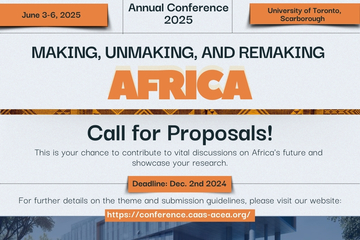
Making, Unmaking, and Remaking Africa!
This is your chance to contribute to vital discussions on Africa's future and showcase your research.Read more and apply here: https://conference.caas-acea.org/
Read more

By: Baboki Gaolaolwe-Major
Due Date: Dec, 2, 2024
Culture and society
+1
Leave a comment
No Preview Available
AREF Research Development Fellowship Programme (Africa)
Deadline: 4th October 2024
Grant size: Fellowship
Donor: AREF Research Development
The Africa Research Excellence Fund is pleased to launch the call for the 2024/25 AREF Research Development Fellowship Programme.
Programme Overview
Aim. To support researchers in Africa who are emerging leaders and working on important challenges for human health, to develop their skills as a researcher.
What we offer. A three to nine-month placement at a leading research institution in the UK, Europe or Africa, with additional support at your home institution before and after the placement. Up to £47,000 available
Who is eligible? Early career researchers. These are research active post-doctoral scientists and clinicians with higher qualifications who are nationals of and employed in Africa (see detailed eligibility criteria).
How to apply. Read the guidance documents carefully before developing your proposal and starting your application. Complete the application form via the portal at https://programmes.aref-africa.org.uk/
https://africaresearchexcellencefund.org.uk/funding-calls/open-funding-research-development-fellowship-2024-25/
Read more
By: Tony Milanzi
Due Date: Oct, 4, 2024
Culture and society
+4
Leave a comment
No Preview Available
Postdoctoral Visiting Fellowships to promote International Research
Deadline: 1st October 2024
Grant Size: Not available
Donor: Kellog Foundation
While at the Kellogg Institute, postdoctoral fellows interact with leading scholars one-to-one and through the Institute’s seminars and lectures, international conferences, roundtable discussions on world affairs, and cultural events. The facilities at the Hesburgh Center are ideal for scholarly research. Fellows have spacious offices, on-site information technology support, and full access to library services, as well as other campus facilities.
We invite applications from scholars who conduct international research on our themes of global democracy and/or human development. Applicants may come from any country and must have recently earned a PhD within the last five years.Most successful applicants will work in a social science discipline or in history. Advanced ABD graduate students may apply, but awards are contingent on their having completed the PhD before June 30 of the starting fellowship year.
https://kellogg.nd.edu/opportunities/visiting-researchers/about-our-postdoctoral-visiting-fellowships#tab-3426
Read more
By: Tony Milanzi
Due Date: Oct, 1, 2024
Youth empowerment
Leave a comment
No Preview Available
Research-Practice Partnership Grants Program
Grant Size: $100,000 to $500,000
Donor: Spencer Foundation
The Spencer Foundation is pleased to announce the Research-Practice Partnership Grants Program to support education research projects that engage in collaborative and participatory partnerships. They view partnerships as an important approach to knowledge generation and the improvement of education, broadly construed. Rigorous partnership work is intentionally organized to engage diverse forms of expertise and perspectives, across practitioners, scholars, and organizations, as well as disciplines and methods, in knowledge generation around pressing problems of practice and/or policy. This grant program is open to existing partnerships between researchers and a broad array of practitioners. For example, practitioners might work in school districts, county offices of education, state educational organizations, universities, community-based organizations, and other social sectors that significantly impact learners’ lives.
https://www.spencer.org/grant_types/research-practice-partnerships
Read more
By: Tony Milanzi
Due Date: Sep, 13, 2024
Agri-food systems
+4
Leave a comment
No Preview Available
ERG Research Grant Programme in LICs
Grant Size: $10,000 to $100,000
The Private Enterprise Development in Low-Income Countries (PEDL) is pleased to announce applications for the Research Grant Programme that aims to better understand what determines the strength of market forces driving efficiency in low-income countries (LICs).
Existing research suggests that the private sector in LICs faces a multitude of constraints that act upon each other. What is needed is research that allows them to understand how these constraints interact.
ERGs are grants of between £10,000 and £40,000. These grants will fund research assistance, data collection and new surveys in LICs, and (if necessary) teaching buyouts for the principal investigator. Please note that cost effectiveness and value for money are important evaluation criteria.
Eligibility Criteria
ERGs are designed to allow researchers to:
Explore new approaches to the study of firms in LICs; and
To develop new (or build on) existing sources of data on firms in LICs.
https://pedl.cepr.org/content/38th-regular-erg-call-open-deadline-19th-august-2024
Read more
By: Tony Milanzi
Due Date: Aug, 19, 2024
Culture and society
Leave a comment
No Preview Available
FRIAS Sustainable Governance Senior Fellowships for Researchers
Grant Size: Fellowship
Donor: Freiburg Institute for Advanced Studies (FRIAS)
The Freiburg Institute for Advanced Studies (FRIAS) is seeking applications for the Sustainable Governance Senior Fellowships to support innovative research projects through individual and group fellowships.
The Freiburg Institute for Advanced Studies (FRIAS) is the University of Freiburg’s international research college. The Institute supports academic exchange across existing boundaries between disciplines, between different cultures and countries, between established and younger researchers.
FRIAS provides modern office spaces and an up-to-date infrastructure and makes every effort to provide tailor-made solutions with regard to suitable accommodation, child care and educational facilities.
https://www.frias.uni-freiburg.de/en/news/call-for-applications/frias-sustainable-governance-senior-fellowship-from-africa
Read more
By: Tony Milanzi
Due Date: Sep, 13, 2024
Culture and society
+1
Leave a comment
No Preview Available
Wellcome Career Development Awards for Researchers
Grant Size: 100,000 -500,000
Donor: Wellcome
Wellcome's Career Development Awards provides funding for mid-career researchers from any discipline who have the potential to be international research leaders.
They will develop their research capabilities, drive innovative programmes of work and deliver significant shifts in understanding related to human life, health and wellbeing.
You can apply for a Wellcome Career Development Award if you are a mid-career researcher and you are ready to lead a substantial and innovative research programme. You must aim to make a key contribution to your field by:
generating significant shifts in understanding
developing methodologies, conceptual frameworks, tools or techniques that could benefit health-related research.
https://wellcome.org/grant-funding/schemes/career-development-awards
Read more
By: Tony Milanzi
Due Date: Nov, 26, 2024
Health and nutrition
Leave a comment
No Preview Available
CFAs: Global Health Policy and Systems Research (HPSR) Projects
The National Institute for Health and Care Research (NIHR) is pleased to launch Global Health Policy and Systems Research (HPSR) Projects to support high quality applied health research to strengthen health policy and health systems in ODA-eligible countries on the Development Assistance Committee (DAC) list.https://www.nihr.ac.uk/funding/global-health-policy-and-systems-research-hpsr-projects-call-2/35549
Read more
By: Tony Milanzi
Due Date: Jan, 1, 0001
Health and nutrition
Leave a comment
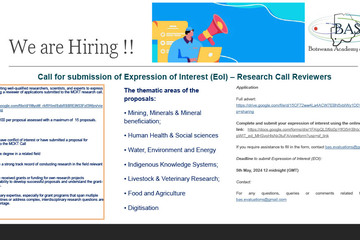
Call for submission of Expression of Interest (EoI) – Research Call Reviewers
The BAS is inviting well-qualified researchers, scientists, and experts to expressinterest in being a reviewer of applications submitted to the MCKT research call.https://drive.google.com/file/d/1MyoM_rkf01lmISxbRS8REiN53FzI5Wjm/view?usp=sharingHonorarium: $100 per proposal assessed with a maximum of 15 proposals.Eligibility1. Should not have conflict of interest or have submitted a proposal forconsideration to the MCKT Call2.Post graduate degree in a related field3. Should have a strong track record of conducting research in the field relevantto the call.4. Should have received grants or funding for own research projectsdemonstrated ability to develop successful proposals and understand the grantwriting process.5. Interdisciplinary expertise, especially for grant programs that span multiplescientific disciplines or address complex, interdisciplinary research questions arean added advantage.The thematic areas of theproposals:• Mining, Minerals & Mineralbeneficiation;• Human Health & Social sciences• Water, Environment and Energy• Indigenous Knowledge Systems;• Livestock & Veterinary Research;• Food and Agriculture• DigitisationApplicationFull advert:https://drive.google.com/file/d/15CF72ww4La4ACW7EBN5xblWy1D0YbMag/view?usp=sharingComplete and submit your expression of interest using the online form at thislink: https://docs.google.com/forms/d/e/1FAIpQLSf9z0pYIfG5rKBhIx7Ag8JFi4-pWIT_ed_MHSvoHlsNx3tuFA/viewform?usp=sf_linkIf you require assistance to fill in the form, contact bas.evaluations@gmail.comDeadline to submit Expression of Interest (EOI):5th May, 2024 12 midnight (GMT)Contact:For any questions, queries or comments related to this call,bas.evaluations@gmail.com
Read more
By: Jayden Hewitt
Due Date: May, 5, 2024
Education
Leave a comment
Partnerships for Innovative Research in Africa (PIRA) Strategic Funding
Partnerships for Innovative Research in Africa
2024 Call for ProposalsInfo session and Q&A slides
The Alliance for African Partnership (AAP), a consortium of ten leading African universities, a distinguished research network for African research institute, and Michigan State University, is inviting proposals for its Partnerships for Innovative Research in Africa (PIRA) strategic funding program. As a consortium-wide initiative, PIRA is a tiered funding opportunity designed to cultivate and support multidirectional, collaborative research partnerships at any stage of their development, whether they are initiatives to explore and create new relationships or scale existing ones. One of the unique aspects to these grants is the expectation that organizations will establish and develop fair and equitable partnerships from conception to closeout of the project, involving local stakeholders throughout the project, respecting their knowledge and expertise, and taking an adaptive approach that is responsive to the local context. Proposals should outline processes to establish such partnerships. Fair and equitable partnerships must also be established among members of the consortium if multiple organizations are working on the implementation of the project. Proposed partnership activities may entail cooperative research, capacity building initiatives, outreach and/or other activities that align with AAP’s pillars of building bridges, transforming institutions, and transforming lives. Proposals must address at least one of AAP’s priority areas: agri-food systems; water, energy and environment; culture and society; youth empowerment; education; health and nutrition; and, science, technology, and innovation.
Proposals are encouraged from diverse disciplinary perspectives. Submitted proposals must include principal investigators from both MSU and at least one African AAP member university. The project implementation timeframe will be 18 months.
FUNDING TIERS
The tiered funding structure is designed to support partnerships at different stages of maturity to create and strengthen relationships among institutions and act as a catalyst for research teams in securing external funding that will allow for long-term engagement. Applicants should submit proposals for the funding tier that best fits the level of engagement established among the PIs on the research team. However, AAP management reserves the right to relegate proposals to a different tier if deemed more appropriate during review. To ensure broad impact, more awards will be given at the planning grant level than the scaling grant level. Proposed activities for each tier may include, but are not limited to:
Planning Grants (up to $50,000), inception and early-stage partnership research activities, travel support for co-developing joint proposals (in accordance with all MSU travel guidelines), short-term capacity building trainings, network development, research symposia, or other activities that align with AAP’s priority themes and strategic objectives.
Scaling Grants (up to $100,000), continuation of ongoing partnerships that have the potential to significantly scale their research, capacity building, or outreach activities, broader institutional linkages, or other activities that align with AAP’s priority themes and strategic objectives.
ELIGIBILITY
The lead investigators for proposals must come from MSU and AAP African member universities. Proposals may also include partners from other institutions globally. Teams are encouraged to include partners from the private sector, governments, civil society organizations, and pan-African/global institutions.
Individuals who were PIs or co-PIs on grants from the previous round of PIRA grants or AAP’s strategic partnership grants are not eligible to lead proposals under this call but may participate as team members.
MSU ISP staff are not eligible to lead proposals.
GUIDELINES FOR APPLICANTS
All submissions must have a cover sheet and proposal narrative that includes the information listed below, a budget and budget narrative using the provided template, and letters of support. Please submit all application material via the application portal by Wednesday, August 14 at 11:59 PM EST.
Application with the project's title as well as names, institutional affiliations, titles of all principal investigators, and a brief (about 100 words) project summary
A proposal narrative, not to exceed 5,000 words with one appendix for references cited, that includes:
A description of the partnership, containing:
Capacity statements from each partner institution that outlines their respective strengths in relation to their proposed roles and responsibilities in the partnership
A brief description of the past or ongoing partnership, if applicable
The rationale for partnership and evidence that it will create or cultivate equitable, sustainable, and mutually beneficial partnerships
A problem statement that identifies the shared challenges to be addressed by the program activities, the theory of change, their relevance to AAP’s themes and pillars
Clearly defined objectives of the proposed partnership
A description of program activities as well as a logical framework that connects the proposed activities with their intended outputs, outcomes, and programmatic objectives
A timeline of activities
A monitoring, evaluating, and learning plan that outlines proposed indicators and collection methods
Identification of potential sources of additional funding that the partnership will pursue during the program’s period of performance
A line-item budget and budget narrative using the template provided. Templates and more information on budgetary considerations are below in BUDGET. A letter of support from each partner’s department, institution, or organization; and A CV or resume of each principal investigator (1-page max).
A letter of support for each PI from their dean or head of department that signifies buy-in from each partner at the institutional level. Please use the provided template
SELECTION CRITERIA
Program goals should align with at least one of AAP’s pillars:
Building bridges: Bringing people and organizations together to work toward common goals. Illustrative activities under this objective include: sponsoring thematic symposia or workshops that bring people together across sectors and disciplines or travel for preparation of proposals for larger grant applications. This also includes network development, communications among research groups or networks (e.g. digital innovations and digital forums), dissemination of knowledge through online journals and/or sharing of best practices among partners
Transforming institutions: Promoting sustainable and effective partnerships among institutions, enhancing resources, and increasing institutional capacity. Illustrative activities under this objective include: institutional capacity development at universities, NGOs, or in the public sector such as building financial management capacity, improving teaching and learning at universities, and/or increasing proposal development skills, among others.
Transforming lives: Supporting research with real-world impact that improves African lives and livelihoods. Illustrative activities under this objective include: putting research into action through evidence-based outreach and engagement, conducting early-stage research that has obvious potential to impact lives and livelihoods, improving dissemination of research outputs to practitioners and policy-makers, and/or designing innovative research-into-practice methodologies.
Submitted proposals will be evaluated according to the following criteria:
Evidence of a collaborative and equitable partnership that strengthens personal, professional, and/or institutional networks in a mutually beneficial and sustainable way. Other AAP principles that need to be demonstrated in the proposal and later in the implementation are mutual trust and respect, sustainability, innovativeness, co-creation, accountability, transparency, flexibility as well as multi-disciplinarity and trans-disciplinarity.
Alignment of proposed activities and program goal(s) to AAP’s 3 strategic objectives and 7 priority areas.
Potential for program deliverables to significantly contribute to their respective academic, technical, or technological fields.
Potential to create innovative models of community engagement and development that positively impact people’s lives.
Potential for principal investigators to attract and or leverage additional external funding to sustain program’s impact.
A thorough monitoring, evaluating, and learning plan that links program activities to their intended outputs and outcomes and includes a clear description of the MEL tools that will be used, what indicators will be measured, and a timeline for evaluation and reporting.
Gender equality, equity and inclusion are core values of AAP and are thus central to this call. All projects funded must demonstrate how they follow principles of gender and inclusion and should explain how applicants will integrate gender, equity, and inclusion issues in all stages of the project, including rationale, design, intended results, data collection, analysis, interpretation, and knowledge mobilization processes.
BUDGET
PIRA BUDGET TEMPLATE [.XLSX]
Using the template provided, applicants must submit a line-item budget and budget narrative for the life of the program that details each institution’s requested budget as well as an overall budget summary. Suggested line items are provided as guidelines but are not comprehensive or required. Proposed budgets should be co-created by the partnership teams and reflect an equitable distribution of funds, with each institution completing a separate tab within the budget template to show the anticipated disbursement of resources and cost sharing broken down by yearly expenditures. The budget narrative should clearly explain how the line items are calculated and for what purpose they will be used in achieving the program’s objectives. Please note that the MSU PI and their home department will be responsible for the financial administration of the award. As such, it is required that the MSU PI involve their department’s fiscal officer in the development of the proposed budget to ensure all financial guidelines and reporting requirements are met. Please submit budgets as an Excel file or similar formatted version that allows the reviewers to view the formulas used in the calculations.
Communications and Engagement10% of the total requested funds must be earmarked for communication and engagement efforts. For example, if a team is requesting a scaling grant for $100,000, at least $10,000 of that must be budgeted for communication and engagement efforts, such as developing creative projects that translate the research, engagement workshops and developing and utilizing dissemination tools such as video production, creation of digital resources, community engagement activities, etc.
Cost Share
10% of the total requested funds must be matched with contributions (monetary and/or in-kind) from all partners. The Co-PIs’ colleges, faculties. and/or departments will be expected to contribute to the costs of the proposed activities to ensure that the commitment to long-term partnering is shared by these units.
Ineligible Expenses
While funding may be used for a variety of activities, the following expenses are not eligible to be covered with the PIRA grants:
Regular salary of MSU faculty (summer salary is allowable)
Indirect costs (IDC)
Equipment exceeding $5,000
Construction-related costs
Total project salary & fringe cannot exceed 30% of total combined project budget.
SELECTION PROCESS
Proposals will initially be reviewed by the AAP management team according to the guidelines and criteria above. Short-listed applications will be assessed by external peer reviewers for quality of technical content. Final selections will be made by the AAP management team in consultation with its internal partners and consortium members.
SUBMISSION AND AWARD TIMELINE
APPLICATION PORTAL
Full proposal packages are due on Wednesday, August 14 at 11:59 PM EST and awards will be announced by early October. AAP management will work with awardees to finalize the plan and budget by November 20, 2024. Programs may begin according to their timeline but not before a final work plan and budget has been approved by AAP management. Programs must begin no later than January 22, 2025 and all program activities must be completed within 18 months of the start date. Progress will be due to AAP management at regular intervals throughout implementation. In addition, AAP will be conducting intermittent surveys of the awardees to evaluate the PIRA grant-making process and how successfully it embodies the AAP’s values of equity, transparency, and accountability.
Read more

By: Justin Rabineau
Due Date: Aug, 14, 2024
Agri-food systems
+6
Leave a comment

African Agriculture Climate Adaptation Research System RFP: Science for Africa Foundation
The RFP seeks innovative approaches to enhance climate adaptation for agriculture in Africa in ways that link directly with and strengthen the ecosystem of local actors and institutions. Specifically, the objective is: To support innovations that strengthen agriculture-related risk management processes and adaptation prioritization, planning, and investment, through intra-Africa research collaboration on data, data science, and modeling.
Due date: January 15, 2023
Grant period: 18-24 months
Seed projects: $100,000 US max; Transition to scale projects: $200,000 US max
Eligibility: Must be led by a PI based in Africa. Teams comprising multiple African institutions within or across countries will be given preference over applicants from single institutions. Other global partners may be included.
At least 90% of the funding must go to an African institution(s).
SAF particularly encourages applications from women-led projects and organization
https://scienceforafrica.foundation/funding/african-agriculture-climate-adaptation-research-system-request-for-proposals
Read more
By: Ann Allegra
Due Date: Jan, 15, 2023
Agri-food systems
Leave a comment
No Preview Available
Technology and Material Culture in African History: Challenges and Potentials for Research
Technology and Material Culture in African History:Challenges and Potentials for Research and Teaching
An international conference, Dar es Salaam, Tanzania, January 4 – 8, 2023
Call for Papers and Roundtables
The conference seeks to consolidate and foster the further development of history of technology and material culture in Africa. By gathering scholars from Tanzania and across Africa, as well as colleagues from other continents, the conference will demonstrate the discipline’s high degree of relevance—to the research and teaching of history and adjacent fields, as well as to contemporary political agendas. The organizers wish to use this event to discuss how historians of technology and material culture may contribute to the writing of a “usable past” for further generations.
The organizers invite historians, archaeologists, anthropologists, geographers, sociologists, and urban scholars to discuss the potentials of interdisciplinary and international collaboration around present intellectual, social, technological, and environmental challenges in Africa and globally. In the recent past, African countries have increased citizens’ access to up-to-date mobility and communication technologies—electric household items, mobile phones, and engine-driven vehicles. As the variety of terms indicates—daladala, matatu, tro tros, bodaboda, bajaji, and so on—artifacts are not just simply imported, but constantly modified to fit local circumstances and needs. By and large, however, a historical understanding of these processes of domestication and reinvention is still lacking. That present-day historians of technology do not limit themselves to the study of modern, Western machines and systems, but include broader aspects of (pre-colonial, colonial, and post-colonial) “material culture,” also means the discipline plays a central role both in research projects and teaching programs.
There have been growing initiatives to integrate Africa into the global history of technology and material culture, but such efforts rarely focus on issues of teaching. Considering the ongoing curricular review at African universities, it is a pressing concern to discuss the potentials of including the history of technology and material culture in Bachelor and Masters programs. The organizers are convinced that the discipline of history needs to include an African perspective and showcase Africa’s contribution to global history of technology and material culture. Therefore, the conference focuses on policies, practices, and use to rethink the historiographic role played by material artifacts and systems. We believe there is a certain urgency in researching, writing, and teaching the history of technology and material culture from a truly African perspective. The organizers hope that the workshop will provide important additions to the nationalist and materialist views which have dominated African history research, writing, and teaching since independence.
By giving participants an opportunity to discuss existing research projects and teaching programs, the organizers aim at laying the foundation for an international network of historians of technology and material culture in Africa. We thus ask interested teachers and researchers from Africa and beyond to contribute with standard workshop sessions and papers, roundtable discussions, and further innovative formats. Proposals may be on any thematic area in history of technology and material culture, for example:
The place of technology and material culture in the teaching of African history
The political “usefulness” of technological and material history
Gender and material culture in African history
Craft technologies (e.g., basketry, carpentry, weaving, pottery, metal working).
Farming, fishing, and hunting technologies
The adoption of material objects (e.g., cars, bicycles, electronic and domestic appliances)
Infrastructure histories (e.g., transportation, water, power, sanitation)
Repair and maintenance cultures
Archaeological evidence
Please submit 300-word proposals and one-page CVs to:Emanuel L. Mchome at emanuellukio@yahoo.com orFrank Edward at f38edward@yahoo.co.uk
no later than August 31, 2022.
This unique event will be organized by the History Department at University of Dar es Salaam in collaboration with the ERC-funded research project “A Global History of Technology, 1850-2000” at the Technical University of Darmstadt in Germany, the Society for the History of Technology (SHOT), and the Foundation for the History of Technology in the Netherlands. The event will take place on site in Dar es Salaam, Tanzania. Lodging and main meals are provided by the organizers; a one-day excursion is also included. Participants from Africa are invited to apply for travel grants. Selected applicants will be notified Sept. 15, 2022, and they will be requested to submit preliminary conference papers (min. 2,500 words) by Nov. 15, 2022. Representatives of leading scientific journals will be present at the event.
Contact Info:
Professor Mikael Hård
ERC Project “A Global History of Technology, 1850-2000”
Institute of History
Technical University of Darmstadt
Schloss, Marktplatz 15
64283 Darmstadt
Germany
Contact Email:
hard@ifs.tu-darmstadt.de
URL:
http://www.global-hot.eu
Read more
By: Raquel Acosta
Due Date: Aug, 31, 2022
Culture and society
+2

Leave a comment