

Results for "research"
113 Results
No Preview Available
Call for Proposals for Research Teams for Women RISE
Research Teams are invited to submit Concept Notes for two-year research projects. Teams successful at the Concept Note stage will be invited to submit Full Proposals.
The following types of research are considered in scope:
Epidemiological studies that describe and analyze patterns of diseases or health among women and consider different population and occupational factors.
Population health research that explores diverse women’s experiences as individuals and within the society (e.g., family and community, intergenerational relationships, socioeconomic groups, work groups and enterprises).
Intervention and Implementation research focused on exploring how policies, practices and strategies already put in place to alleviate the impact of COVID-19 influence the relationships between women’s paid and unpaid work and their health.
Specific Research Areas
A subset of funds is available to support research that is relevant to the scope and objectives of Women RISE and specifically addresses one of the following three Specific Research Areas:
Infectious diseases research focused on understanding how relationships between women’s work and health have been shaped by and are shaping disruptions to infectious disease prevention, immunization programs and care services.
HIV/AIDS STBBI research specific to women living with HIV/AIDS, COVID-19-related disruptions to HIV and STBBI prevention or care services, or the health of women in occupations that put them at increased risk for HIV and STBBI acquisition.
Pandemics and other health emergencies research that investigates ways the COVID-19 experience can inform, improve, and safeguard women’s health and socioeconomic well-being against future health emergencies.
Eligibility
The Research Team must include a Principal Investigator (PI) who is a low- and middle-income country (LMIC) researcher based in the LMIC Lead Applicant Organization and residing in an eligible LMIC country/territory where the research is proposed. The PI will be the team lead and will work in close collaboration with a Canada-based Co-Principal Investigator (Co-PI) and a Decision-Maker Co-PI based in the same country as the Lead Applicant Organization or in a country where the research will take place. For applications involving Indigenous communities, the RT must include at least one member who self-identifies as Indigenous or provides evidence of having meaningful and culturally safe involvement with Indigenous Peoples in an Indigenous Health Research Environment.
The Research Team must also include a Lead Applicant Organization and a Canadian Co-Applicant Organization.
More details
For more information, please read the detailed call for concept notes.
Please also consult our frequently asked questions.
Read more

By: Raquel Acosta
Due Date: Apr, 12, 2022
Culture and society
+1
Leave a comment
No Preview Available
Einstein Foundation Award for Promoting Quality in Research
The Einstein Foundation Berlin has announced an international award to provide publicity for researchers and institutions seeking to improve the quality of research.Einstein Foundation Award for Promoting Quality in Research is the first award to recognize outstanding efforts that enhance the rigour, reliability, robustness, and transparency of research.To honour researchers and institutions whose work helps to advance the quality and robustness of research findings, awards worth €500,000 have been allotted across various categories.
Individual researchers or small teams of collaborating researchers can be nominated. The laureate will be awarded €200,000.
Governmental and non-governmental organizations, institutions, or other entities can apply or be nominated. The award-winning organization or institution will receive €200,000.
Early career researchers or small teams of collaborating researchers can submit a project proposal that seeks to foster research quality and value for an award of €100,000
Nominations and applications close on April 30, 2022
Apply now: Award – Einstein Foundation Berlin
Read more
By: Raquel Acosta
Due Date: Apr, 30, 2022
Education
Leave a comment
No Preview Available
2022 ASMEA Research Grant Program
To stimulate new and diverse lines of discourse about the Middle East and Africa, ASMEA’s Research Grants Program seeks to support research on topics that deserve greater attention. The topic areas and sub-topics listed below are intended as a guide for potential participants in the program and constitute the types of subjects that ASMEA intends to support. An applicant may submit a proposal on any topic as long as it is directly relevant to the five broad areas outlined below, and constitutes new and original research. Grants of $2500 will be awarded. For eligibility and requirements, refer to the grant guidelines.
Topic Areas:
Minorities and Women
Feminism, women’s rights, family law
Christians in the Middle East and Africa
Alevis, Bahai, Berbers, Druze, Kurds, Yazidis
Military History
Terrorist groups- ideologies, intentions, and methods
Conventional conflict and proxy war
Approaches to national security, deterrence, and proliferation
Governance and Economy
Maintaining power- elections, patronage, coercion
Political and economic reform movements
Economy and state corruption
Dealing with bounty: oil, gas and other resources
Faith
Islamism
Islamic heterodoxy
Islamic reform movements
Shia/Sunni rivalry
Iran
Current political affairs
Center vs. periphery and Persians vs. minorities
Traditional approaches to domestic rule and empire
Expressing opposition- protest, culture, youth, migration, violence
The deadline to submit is April 15, 2022. Contact ASMEA at info@asmeascholars.org for questions on the application process.
Link to apply/more info: 2022 Research Grant Program (asmeascholars.org)
Read more
By: Raquel Acosta
Due Date: Apr, 15, 2022
Culture and society
+1
Leave a comment
No Preview Available
Einstein Foundation Award for Promoting Quality in Research
The Einstein Foundation Award for Promoting Quality in Research aims to provide recognition and publicity for outstanding efforts that enhance the rigor, reliability, robustness, and transparency of research in the natural sciences, the social sciences, and the humanities, and stimulate awareness and activities fostering research quality among scientists, institutions, funders, and politicians. To acknowledge the outstanding role early career researchers (ECRs) have in promoting research quality, ECRs will be invited to propose projects that foster research quality and value. Projects will be competitively selected for funding and internationally showcased.
The Einstein Foundation Award honors individual researchers from all fields, as well as collaborations, institutions, and organizations (NGO or governmental), that
have made substantial contributions to fostering research integrity through outstanding measures that increase the quality and reliability of research, e.g. by improving transparency, access to research results (‘Open Science’), overcoming the fragmentation of research (‘Team science’);
have developed and/or implemented quality-improving interventions, governance and policies;
have delivered groundbreaking research on research to identify opportunities for improving research practice, have generated evidence for potential interventions, and have developed metrics and policies that incentivize the adoption of best possible research practices;
have developed innovative approaches that foster research on research integrity, have conducted and designed novel measures or programs preventing misconduct and safeguarding validity and reliability in science and research;
have identified and addressed systemic factors leading to improved research integrity and more responsible research;
have performed or supported studies on the reproducibility of scientific results;
have made a significant contribution to the teaching of good research practice;
have identified research standards and incentives that directly or indirectly constrain the quality of research (e.g. reliance on purely quantitative output measures) and have designed more adequate means to assess the quality of research and researchers;
have demonstrated exceptional integrity when facing difficult circumstances and/or conflicts of interest;
have significantly contributed to increasing the diversity of research by taking into view aspects such as gender, race/ethnicity, geography, career stage, etc.;
guarantee the long-term archiving of data and publication (generation-spanning archives);
or that seek to make such developments and/or contributions in future
Award Categories
The Einstein Foundation will honor successful candidates in the following three categories:
Individual Award: Individual researchers or small teams of collaborating researchers can be nominated. The laureate will be awarded €200,000.
Institutional Award: Governmental and non-governmental organizations, institutions, or other entities can apply or be nominated. The award-winning organization or institution will receive €200,000. If governmental organizations or institutions are the recipients of the award, they will not receive any funds in addition to the award itself. Non-Governmental organizations can be publicly funded; although government representatives may sit on an NGO’s governing board(s), governments cannot unilaterally determine the use of the organization’s funds, its structure, or its activities.
Early Career Award: Early career researchers or small teams of collaborating researchers can submit a project proposal that seeks to foster research quality and value for an award of €100,000.
Eligibility and Requirements
This award is open to any researcher or group of researchers, organizations, or institutions involved in science and research, education, and scholarship. To be eligible for the early career award, candidates must hold a doctorate or have equivalent research experience, and should have been an independent researcher for no longer than five years.
Nominations of individual or small teams should include a nomination letter, a CV, and a list of relevant publications of each nominee, as well as letters of support from eminent experts and former trainees.
Applications or nominations of organizations and institutions should consist of a nomination or application letter, as well as letters of support from eminent experts.
Early career researchers or small teams of early career researchers should submit a letter of motivation, a project proposal, as well as a CV and a list of relevant publications for each team member.
Find out more about the nomination and application requirements in the different categories.
Learn more: https://www.einsteinfoundation.de/en/award/?sap-outbound-id=DA302B06ABF7EE060E3DEC6F13812012898900E7&utm_source=hybris-campaign&utm_medium=email&utm_campaign=000_SDR8597_0000020206_CONR_AWARD_APPL_GL_SCON_EFA22_NomEFA22&utm_content=EN_internal_38102_20220301
Read more
By: Raquel Acosta
Due Date: Apr, 30, 2022
Education
Leave a comment
No Preview Available
TWAS – Women in Climate Action research grants
To support action-based projects with a direct impact on society, the Elsevier Foundation is partnering with TWAS – the World Academy of Sciences to provide research grants for projects led by women scientists that address concrete problems in climate change through collaboration and interdisciplinary research.
The program is community-focused: a competitive, open call for applications will consider projects that respond to the needs of, and to the development requirements, of the applicants’ community and/or national or regional context in one of the 66 scientifically and technologically lagging country (STLCs). The TWAS-Elsevier Foundation Project Grants Programme for Gender Equity and Climate Action aims to:
• Promote gender equality by creating opportunities for women in climate action projects that take them outside the lab, enabling them to deepen their scientific skills, while acquiring, through training, soft skills such as project management and leadership.
• Respond to and tackle communities’ needs in ways that are in line with the principles of sustainable development, focusing on the brunt of climatic changes.
• Effectively transfer knowledge from scientific research to real-life scenarios for practical and tangible change under the umbrella of the “climate action” SDG.
Knowledge deriving from scientific research often suffers from not being applicable to real-life scenarios, especially in the Global South – slowing down tangible improvements. Greater progress in the livelihoods of individuals are achieved when research is done in cooperation with local populations, and when scientific know-how is effectively shared by those living in the same communities. UN Women reports that globally, one fourth of all economically active women are engaged in agriculture, where they regularly contend with climate consequences such as crop failure and experience an unequal burden of care for collecting increasingly scarce water and fuel.
The grants will support women researchers from the Global South to reinforce both scientific and soft skills such as project management, leadership and science diplomacy – with the aim of sustainably improving the livelihood of their entire community by supporting women’s wellbeing.
To learn more: https://elsevierfoundation.org/partnerships/inclusive-research/twas-women-climate-action-research/
Read more
By: Raquel Acosta
Due Date: May, 19, 2022
Culture and society
+2
Leave a comment
No Preview Available
AGRILINKS EVENT: Managing Soils to Address Global Challenges
Join us for the 2022 USAID Bureau for Resilience and Food Security (USAID/RFS) Research Honorary Lecture, given by 2020 World Food Prize Laureate Rattan Lal. Dr. Lal is recognized globally as a pioneer in soil-centric agricultural management to improve food security and develop climate-resilient agriculture through soil carbon sequestration, sustainable intensification, use efficiency of agroecosystems, sustainable management of soils, and soil health. His career in soil science and international agricultural research spans over 5 decades and four continents.
The lecture and discussion will outline global challenges including food and nutritional insecurity, climate change, soil degradation, water scarcity, and pollution. This presentation will also highlight Dr. Lal’s modeling research for achieving sustainable and resilient production systems to restore soil health. The strategy involves producing more from less and returning land back to nature.
To register: https://primetime.bluejeans.com/a2m/register/sgghvjcz
Read more
By: Raquel Acosta
Due Date: Feb, 24, 2022
Agri-food systems
+1
Leave a comment
No Preview Available
GLOBAL ALLIANCE FOR RAPID DIAGNOSTICS
We are a multidisciplinary group of researchers and practitioners from around the world committed to improving global health by reducing infectious diseases through early diagnosis.
Vision: Prevent illness, save lives, and improve quality of life through rapid diagnostics.
Mission: To develop portable, affordable, and globally deployable nano-enabled biosensor technologies for rapid and early detection of infectious and antimicrobial resistant diseases in populations who need help the most but can afford the least.
Output: Publications and presentations, joint funding, capacity building (workshops and lectures), student research, and faculty/student training, global symposia, global/local strategies
REGISTER FOR FREE FOR THE 2022 SYMPOSIUM AND SHORT COURSES
Read more
By: Raquel Acosta
Due Date: Feb, 25, 2022
Health and nutrition
Leave a comment
No Preview Available
ASMEA Travel and Research Grant Opportunities
The Association for the Study of the Middle East and Africa (ASMEA) is offering two grant opportunities in conjunction with its Fifteenth Annual Conference taking place in Washington, D.C. on November 5 - 7, 2022.
The ASMEA Research Grant Program seeks to support research on topics in Middle Eastern and African studies that deserve greater attention. Applicants may submit paper proposals on any topic as long as it constitutes new and original research and is relevant to the five qualifying topic areas: Minorities and Women, Military History, Governance and Economy, Faith, and Iran. Grants of up to $2500 will be awarded. Successful research grant applicants are required to present their research at the Fifteenth Annual ASMEA Conference. The deadline to apply is April 15, 2022.Separately, ASMEA is offering Travel Grants of up to $750 which can be used towards the costs associated with attending the Annual ASMEA Conference in Washington, D.C. The deadline to apply is April 15, 2022.
Additional guidelines and information can be found on our website at www.asmeascholars.org.
Feel free to contact ASMEA at info@asmeascholars.org with any questions.
Read more
By: Raquel Acosta
Due Date: Apr, 15, 2022
Culture and society
Leave a comment
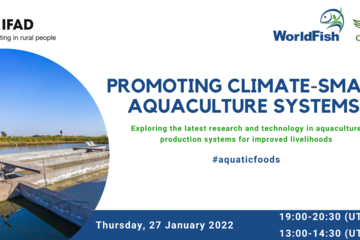
Promoting climate-smart aquaculture systems A virtual discussion
A virtual discussion exploring the latest research and technology in aquaculture production systems for improved livelihoods.Thursday, 27 January 202219:00-20:30 (UTC+8) / 13:00-14:30 (UTC+2)
Click here to register and save your spot
The Advancing Climate-Smart Aquaculture Technologies (ACliSAT) project promotes climate-resilient and sustainable aquaculture practices of the Nile Tilapia for different water and environmental conditions in Egypt, Eritrea, and Ethiopia. The project's work focuses on aquaculture systems such as the Improved Pond Raceway Aquaculture System (IPRAS) and Integrated Aquaculture-Agriculture system (IAA), that optimize water use efficiency and adapt to different environmental conditions are important for successful tilapia farming in arid lands. WorldFish and IFAD are organizing a joint webinar to share the research findings, knowledge, and know-how on the climate-smart aquaculture systems gathered from the ACliSAT project. The webinar aims to promote IPRAS and IAA as production systems that enable intensification of Tilapia production, the efficient use of natural resources and feed nutrients, and managing waste and loss by re-using wastes such as pond water and mud as crop fertilizer.Climate-smart aquaculture systems are of particular importance in mitigating the pressing effects of climate change as well as adapting to the changing climate conditions that directly affect the food security, nutrition, and livelihoods of millions of vulnerable people in developing countries.
Follow WorldFish and the hashtag #aquaticfoods to join the virtual dialogue on Twitter. We look forward to your active participation. To register: Webinar Registration - Zoom
Read more
By: Raquel Acosta
Due Date: Jan, 27, 2022
Water, energy, and the...
Leave a comment

No Preview Available
Online Lecture Series - Poverty Violence and Migration in the Red Sea Region
This lecture series will showcase new research into the historical causes and contemporary dynamics of structural poverty, political violence, and large-scale migration in the Red Sea Region. The invited speakers each recognize the continuing importance of longstanding intra-regional connections, and their lectures will shed light on the ways that the coping strategies currently pursued at individual, household, community, and state levels are shaped by the legacies of past practices.
More information can be found at:
https://www.zmo.de/en/events/lecture-series/vortragsreihe-im-akademischen-jahr-21-22
To obtain the zoom meeting details, please register at:
https://tinyurl.com/5xswd368
This lecture series is organized by Dr. Steven Serels of the Leibniz-Zentrum Moderner Orient in Berlin in coordination with RedSeaNet.
Read more
By: Raquel Acosta
Due Date: Oct, 13, 2021
Culture and society
+1
Leave a comment

Partnerships for Enhanced Engagement in Research (PEER) 2021/2022 Solicitation
On August 23, 2021, PEER released its latest call for proposals, which aims to support research projects that focus on the impacts of COVID-19 and potential solutions that can emerge from this pandemic. The COVID-19 pandemic has led to unprecedented global challenges and uncovered weaknesses in the ability of governments, the private sector, and local and international actors to deliver services and resources across many systems. This has been true in food and agriculture, healthcare, and education, among other sectors. However, the pandemic also has inspired innovation in areas such as digital technology and social organization, and there are many examples of countries or communities effectively coordinating to confront this threat. This PEER funding opportunity looks to support locally-led research projects that (1) aid in our understanding of how shocks such as COVID-19 affect key sectors in developing countries and (2) test approaches to help communities and sectors respond to and mitigate the effects of COVID-19 or similar future shocks.Projects funded under this year’s call for applications will receive one-year awards of up to US $70,000. In addition, they will receive personalized training and guidance from USAID’s Research Technical Assistance Center on developing evidence-to-action plans and communications products. The deadline for submission of pre-proposals is October 22, 2021. For further details please review the Request for Applications.
Read more

By: Derek Tobias
Due Date: Oct, 22, 2021
Health and nutrition
Leave a comment
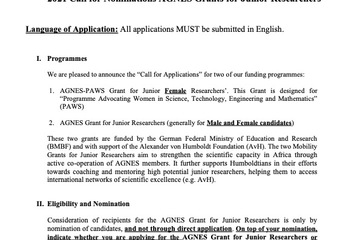
2021 Call for Nominations AGNES Grants for Junior Researchers
https://repository.ruforum.org/system/tdf/AGNES-JUNIOR-RESEARCHER-GRANT-CALL-2021.pdf?file=1&type=node&id=39369&force=&utm_source=RUFORUM+Mailing+List&utm_campaign=d18db56afe-RUFORUM+Weekly+-+Vol.3+No.25_COPY_01&utm_medium=email&utm_term=0_1fcfbb8a0b-d18db56afe-346973753&ct=t()&goal=0_1fcfbb8a0b-d18db56afe-346973753&mc_cid=d18db56afe&mc_eid=d95cf18a8d
Read more

By: Madeleine Futter
Due Date: Sep, 28, 2021
Youth empowerment
+1

Leave a comment