


Results for "mental health"
2 Results
Beyond the Playing Field: Advancing Global Mental Health for International Student-Athletes
Reflecting on who I am and what makes me who I am, it becomes evident that my research interests parallel my lived experiences. As a Japanese American woman raised in the United States and a former student-athlete, I grew up in spaces where perseverance was praised (and often expected), and vulnerability was often considered a weakness. Mental health was rarely discussed openly, and strength was frequently associated with self-reliance. Within athletics, performance and success often came before personal health and well-being. Over time, the intersection of these cultures contributed to my first experiences with mental health challenges and significantly molded the lens through which I view and understand health, struggle, and support in sport.
My current work focuses specifically on international student-athletes (ISAs) competing in the National Collegiate Athletic Association (NCAA). Although they represent roughly 5% of NCAA athletes, ISAs account for over 25,000 individuals who navigate the complexities of higher education, elite sport, and cultural transition. These athletes often face challenges that may include but are not limited to language barriers, pressure to perform, social isolation, and culture shock – all of which can impact mental health and overall well-being.
Given this context, my research journey has been shaped through meaningful collaboration across institutions. My first published study qualitatively explored mental health and help-seeking behaviors among NCAA Division I ISAs throughout their transition, in collaboration with my master’s advisor, Matt Hoffmann, at California State University, Fullerton. The findings underscored the prevalence of mental health stigma as a barrier to help-seeking and the importance of peer support in navigating cultural transitions. Building on this work, I recently co-authored a scoping review of ISA mental health and help-seeking with my current doctoral advisor, Dr. Leapetswe Malete, at Michigan State University, which is now in press. Currently, Dr. Malete and I are further expanding on this research by examining how support from fellow international student-athletes evolves across the phases of cultural transition and which types of support are most meaningful or missing.
Collaboration has strengthened and continues to strengthen this work in important ways as each member of our research team(s) brings their own lived experiences shaped by time spent studying, working, or living in different countries. These diverse perspectives encourage us to question assumptions and remain considerate of cultural nuance and context. In this research that focuses on international populations, cultural responsiveness must be actively addressed. Ongoing conversation allows for the design of studies that are inclusive and sensitive to the intricacies of identity and culture across various contexts. As I have been presently learning, this collaborative approach is imperative for remaining both reflective and reflexive of world perspectives, instead of a single institutional lens.
Across these projects, my colleagues and I purposefully used qualitative methods to amplify the voices of those who are often overlooked or unheard. Through in-depth, semi-structured interviews with NCAA ISAs, I aim to create a safe space for participants to share their unique stories to produce actionable research grounded in lived experiences. Many participants are highly visible on their sport’s playing field, but are frequently unheard at an institutional level. That said, this approach seeks to help bridge that gap and inform tangible changes within universities.
With the continued increase in international student migration around the world, institutions are becoming increasingly diverse and interconnected. As universities expand global partnerships, including collaborations between African institutions and U.S. universities through networks such as the Alliance for African Partnership, it becomes increasingly important to recognize how well-being is affected by cultural transition. Therefore, my research aims to advance understanding of global mental health by highlighting how migration, stigma, and culture intersect within an understudied population (i.e., ISAs). By applying a theoretical framework, this research illustrates that mental health and well-being evolve over time within transitional contexts. Interpreting these shifts allows institutions to anticipate challenges within these communities, rather than react when distress becomes visible.
While our current research has examined ISAs migrating to the U.S., its findings have practical implications for university policies and student support systems across the globe. Institutions that enroll international students may benefit from intentionally creating opportunities for connection early in the transition process. Our findings suggest that ISAs often value relationships with others who share comparable experiences. Furthermore, peer support from other international students is consistently reported as the most meaningful and helpful form of connection. By proactively facilitating these connections, institutions can shift from reactive toward preventative approaches that foster inclusive environments where not just ISAs, but all students are able to experience more consistent states of overall positive well-being.
Conducting research with ISAs, has been both rewarding and humbling. Mental health remains stigmatized in many contexts, resulting in difficulty recruiting participants and in quickly cultivating a space that feels psychologically safe enough for them to open up about personal struggles. Learning and engaging in qualitative research has constantly reminded me that my own background shapes how I interpret and interact with the participants and the data. These projects have reinforced the importance of mindfulness and reflexivity in research, and in recognizing that I inevitably play a role in how others’ lived experiences are conveyed.
While our research thus far focuses on ISAs in the U.S., cultural transition and student well-being are worldwide experiences. Looking ahead, I hope to continue expanding this work through engagement with researchers and institutions across nations, to better understand the nuances of various cultural contexts, the challenges they may bring, and their effects on wellness. Moreover, it is my hope that this research contributes to global conversations on mental health and encourages more translational research into preventive and inclusive approaches to supporting students across diverse institutional settings.
By:
Baboki Gaolaolwe-Major
Thursday, Mar 5, 2026
HEALTH AND NUTRITION
+2

Leave a comment
Strengthening Child Mental Health in the DRC: From Early Caregiving to School-Age Resilience
Children’s mental health is deeply shaped by the environments in which they grow—and at the center of that environment is the family. In low- and middle-income countries (LMICs), where families often navigate poverty, limited infrastructure, and fragile health systems, understanding how early caregiving influences long-term mental health is both urgent and transformative.
A new NIH-funded longitudinal study led by faculty at Michigan State University is addressing this critical question in the Democratic Republic of the Congo (DRC). Building on a previous early childhood parenting intervention, the project examines whether strengthening caregiving practices early in life can produce lasting mental health benefits as children reach school age.
At the heart of the study is the Mediational Intervention for Sensitizing Caregivers (MISC), a year-long, biweekly parenting support program designed to enhance responsive caregiving and promote children’s early cognitive and emotional development. While programs like MISC have demonstrated clear short-term benefits, far less is known about whether these early gains translate into sustained improvements in mental health as children grow older. This study seeks to close that gap.
Researchers are following 100 children whose mothers previously completed the MISC intervention and 114 children whose mothers received standard care. Over a three-year follow-up period, children’s mental health is assessed annually using a comprehensive set of tools, including measures of executive functioning and self-regulation, emotional and social communication assessments, video-recorded caregiver–child interactions, standardized mental health checklists, and innovative eye-tracking technology that measures children’s responses to short video scenes depicting distress and comfort. By combining behavioral observation with physiological and cognitive indicators, the study offers one of the most comprehensive examinations of child mental health trajectories in the region.
Importantly, the project does more than evaluate whether MISC works—it seeks to understand how and why it works. Researchers are examining family social factors such as caregiving environment, parental self-efficacy, and school attendance, alongside maternal mental health and child growth indicators. These factors are analyzed both as pathways through which the intervention may influence outcomes and as independent predictors of child mental health. The study also takes a dyadic perspective, recognizing that child and caregiver mental health are deeply interconnected. By assessing reciprocal influences over time, the research captures the dynamic processes that may strengthen resilience—or heighten vulnerability—within families.
The study is led by Dr. Itziar Familiar-Lopez and Dr. Michael Boivin of the Department of Psychiatry at Michigan State University. Dr. Boivin brings more than three decades of experience in child neurodevelopment research in Sub-Saharan Africa, while Dr. Familiar-Lopez contributes extensive expertise in maternal mental health, family systems, and longitudinal global mental health research. In-country leadership and partnership are central to the project’s success, with Dr. Desire Tshala and his team at the Institute National pour la Recherche Biomedical working closely with Dr. Zacharie Mulumba, a Congolese researcher and Mandela Washington Fellow.
For Dr. Mulumba, the project has been both professional and deeply personal. After being selected among more than 10,000 applicants for the Mandela Washington Fellowship, he completed a six-week Civic Engagement program at Michigan State University. There, an introduction to Dr. Boivin sparked a collaboration that would take him from East Lansing to Kahemba, a remote region in the DRC heavily affected by konzo—a neurological condition linked to cyanide exposure from improperly processed cassava.
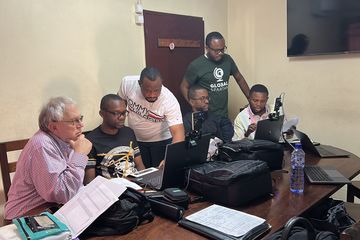
Before returning home, Dr. Mulumba received training in eye-tracking technology, which was being used for the first time in this setting. Soon after, he traveled by road for two days—nearly 19 hours on the second day alone—to reach Kahemba. The challenges were immense: impassable roads, limited infrastructure, families relying on seasonal forest activities for survival, and children affected by konzo with severe motor impairments. Despite these barriers, the research team conducted eye-tracking assessments with approximately 130 children. Community members were welcoming, and conversations with parents—particularly mothers—offered powerful insight into daily realities and resilience.
Returning to Kinshasa after weeks in Kahemba felt, in Dr. Mulumba’s words, like “entering another world.” The experience underscored a central lesson of global health research: local context, patience, and partnership are indispensable.
Mental health disorders account for a growing burden of disease globally, yet prevention strategies tailored for LMIC contexts remain limited. By establishing whether early parenting support produces durable mental health benefits—and identifying the family and developmental mechanisms that drive those effects—this study provides critical evidence for scalable, culturally responsive interventions.
At its core, this work reminds us that strengthening caregiver–child relationships early in life may be one of the most powerful tools we have to promote resilience, dignity, and long-term well-being. Through sustained partnership and shared commitment, this collaboration between researchers in the United States and the DRC is helping to shape a future where children’s mental health is supported not only in theory, but in practice—within the communities where it matters most.
By:
Baboki Gaolaolwe-Major
Friday, Mar 20, 2026
HEALTH AND NUTRITION
+1

Leave a comment