

Browse
Education
Celebrating Women in Science: Dr. Tabitha Amollo's Journey Towards Solar Innovation
As the world celebrates the International Day of Women and Girls in Science, it's essential to shine a spotlight on the remarkable achievements of women scientists like Dr. Tabitha A. Amollo, whose dedication and passion for physics and materials science are driving transformative advancements in solar energy.
Tabitha, with a Ph.D. in physics specializing in solid-state physics and materials sciences from the University of KwaZulu-Natal, stands at the forefront of research in materials and device engineering for solar energy conversion. Through the Alliance for African Partnership’s African Futures Mentorship Program, Tabitha has been selected to receive leadership mentorship program that is facilitated between Michigan State University (MSU) and her home institution, Egerton University. This program enables upcoming and very talented scientists to receive career guidance by two mentors from MSU and the home university. Her current research at Michigan State University focuses on developing high-efficiency monolithic silicon-perovskite solar cells, a crucial step towards harnessing solar energy more effectively.
In an exclusive interview, Dr. Amollo shared insights into her groundbreaking research and her vision for the future of solar energy in Africa. "Solar energy is abundant in Africa," she remarked, expressing her dream of seeing every home on the continent electrified. Her work is not merely academic but holds the potential to revolutionize energy access for millions.
Despite facing challenges such as limited resources and infrastructure, Dr. Amollo remains undeterred in her pursuit of innovation. She emphasized the importance of optimizing thin film growth for solar cells, using techniques like ion beam-enhanced magnetron sputtering to achieve high-quality results even at low substrate temperatures.
Reflecting on her experiences, Dr. Amollo highlighted the contrasting environments for research and innovation between MSU and her native Kenya. "The business environment at MSU is very friendly," she noted, emphasizing the need for a supportive ecosystem to nurture scientific talent. Dr. Amollo's passion for advocacy extends beyond her research laboratory. She is committed to promoting hands-on learning experiences for students, advocating for increased access to research funding, and streamlining the innovation ecosystem in Africa. "In Africa, we do not lack innovative ideas; our main challenge is the fragmented or lack of a functioning ecosystem," she observed.
Looking ahead, Dr. Amollo envisions a future where African universities are equipped with state-of-the-art facilities, empowering the next generation of scientists to pursue their dreams fearlessly. "The opportunity is great; I can do so much," she remarked, acknowledging the constraints of time but remaining optimistic about the impact of her work.
As we celebrate the International Day of Women and Girls in Science, let us honour trailblazers like Dr. Tabitha A. Amollo, whose dedication and ingenuity are driving progress towards a more sustainable and equitable future for all.
Dr. Amollo's work serves as a beacon of inspiration, reminding us of the transformative power of women in science and the crucial role they play in shaping our world for the better.
By:
Jayden Hewitt
Wednesday, Mar 13, 2024
EDUCATION

Leave a comment
How Lemon and Cherry Kitchen Experiments Led to a Big Science Career
In many families and communities, it’s not so common for children to turn their childhood playground interests into a career. Often, children follow the dreams and expectations of their parents who tend to push them toward a career based on what they know or traditional notions of what careers yield stability and success, such as a medical doctor, a nurse, a lawyer, or a police officer.
For Dr. Sharon Hooper, a distinguished Research Specialist at Michigan State University and a principal investigator of an AAP Partnerships for Innovative Research in Africa (PIRA) award, it's different. Sharon and her team from Jamaica and South Africa are making notable strides in the realm of food science and nutrition, and it all started from her mom’s kitchen in Jamaica.
Her journey into this field began in her childhood home, where she developed a fascination for food and its myriad tastes. “When I was young, I experimented a lot with food. My mom would send me to make fruit juices from scratch on Sundays as my contribution to the family meal; I would get to the kitchen, blend cherries, add lemon juice and watch the color change from light to deep red. I later learned that the acid from lemons affected the pH of the juice as well as the anthocyanin pigment of the cherries. This phenomenon really fascinated me and struck my curiosity, so I have always experimented a lot with food,” says Sharon. This early passion evolved into a profound interest in Food Science and Nutrition, shaping her career as a scientist. Now Sharon leads a global team that seeks to address health and nutrition by targeting the nutrient deficiencies of at-risk populations in South Africa, Jamaica and the U.S. through the formulation of innovative nutrient dense composite flours. This is a noble gesture that contributes to the ongoing global efforts of reducing high rates of malnutrition, especially among children.
Diet-related chronic non-communicable diseases such as diabetes and obesity have become a common phenomenon in developed countries and among urban populations in developing countries. Sharon and her team’s research project are unearthing innovations around common and recognizable food crops such as dry beans, maize, cassava, and vitamin A biofortified sweet potato (grown in South Africa, Jamaica, and the U.S.) and turning them into nutrient dense composite flours for improved (bioavailable) iron and vitamin A, and for protein quality.
Additionally, by focusing on ingredients derived from local raw materials, the team believes that an increase in market demand for alternative flours will ultimately benefit the lives and livelihoods of local farmers in import-dependent economies. “In each of our partner countries, there is limited availability of economical, nutrient-dense flours for (small-scale) food manufacturers. And the subsequent unavailability of affordable, nutrient-rich, convenient foods for low- and medium-income urban consumers may contribute to malnutrition,” she said. According to Sharon, it is therefore important to use sustainable and easily accessible (economically and physically) food crops, already in use by the target population.
Driven by her commitment to positively impact future generations, Sharon focuses on the vital task of educating people about the benefits of indigenous foods. Her project under the PIRA program targets the development of novel composite flours using cassava, a crop indigenous to both Africa and Jamaica. The project encompasses diverse culinary applications, with South Africa focusing on pap and porridge, Jamaica on instant porridge and bread, and the U.S. team exploring pancakes and pasta. Growing up in a Jamaican family and participating in the food preparation, “always brought joy” to Sharon’s heart.
Sharon believes deeply in the importance of continual learning and the adaptability of science. She emphasizes the dynamic nature of research and is quick to point out that excessive comfort in one's knowledge is a barrier to innovation and growth. Her approach reflects a deep understanding of the evolving nature of science and its potential to impact society.
Her work, therefore, is not just a scientific pursuit but a holistic endeavor to improve food security and nutrition while nurturing the next generation of scientists and entrepreneurs. Sharon’s story is a testament to the power of passion, education, and innovation in addressing some of the pressing issues in food science today. Most importantly, her story is a reminder of why we need to pay attention to what children really love and their unique talents.
By:
Jayden Hewitt
Wednesday, Mar 13, 2024
EDUCATION

Leave a comment
Seventeenth Annual ASMEA Conference CALL FOR PAPERS & PANELS
Washington Marriott Georgetown November 2-4, 2024
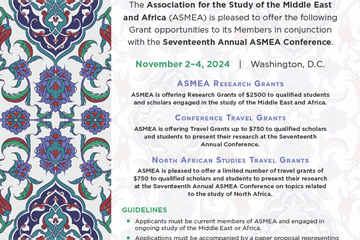
ASMEA is currently seeking proposals for outstanding paper and panel presentations at the Seventeenth Annual Conference. Scholars from any discipline, tenured or nontenured faculty, or those otherwise affiliated with a recognized research institution, may submit proposals to present at the Conference. Unique proposals from senior graduate students (ABD) will also be considered. Proposals on topics related to the Middle East and Africa should consist of a one-page summary outline of new and unpublished research. A recent C.V. with all contact data also must be included with name, e-mail, phone number, and affiliation. The deadline for proposals is May 1, 2024. In conjunction with the Seventeenth Annual Conference, the following GRANT OPPORTUNITIES are available to ASMEA Members:ASMEA Research Grants ASMEA is pleased to offer research grants of $2500 to qualified scholars and students engaged in the study of the Middle East and Africa. Application deadline is April 15, 2024. Conference Travel GrantsASMEA is offering travel grants up to $750 to qualified scholars and students to present their research at the Seventeenth Annual Conference. Application deadline is April 15, 2024.North African Studies Travel GrantsWe are pleased to offer a limited number of travel grants of $750 to qualified scholars and students to present their research at the Seventeenth Annual ASMEA Conference on topics related to the study of North Africa. Application deadline is April 15, 2024.Questions? See our FAQ or contact ASMEA at 202.429.8860 or info@asmeascholars.org.
Association for the Study of the Middle East and Africawww.asmeascholars.org
By:
Jayden Hewitt
Saturday, Mar 2, 2024
EDUCATION
Leave a comment
Seventeenth Annual ASMEA Conference CALL FOR PAPERS & PANELS
Washington Marriott Georgetown November 2-4, 2024
ASMEA is currently seeking proposals for outstanding paper and panel presentations at the Seventeenth Annual Conference. Scholars from any discipline, tenured or nontenured faculty, or those otherwise affiliated with a recognized research institution, may submit proposals to present at the Conference. Unique proposals from senior graduate students (ABD) will also be considered. Proposals on topics related to the Middle East and Africa should consist of a one-page summary outline of new and unpublished research. A recent C.V. with all contact data also must be included with name, e-mail, phone number, and affiliation. The deadline for proposals is May 1, 2024. In conjunction with the Seventeenth Annual Conference, the following GRANT OPPORTUNITIES are available to ASMEA Members:ASMEA Research Grants ASMEA is pleased to offer research grants of $2500 to qualified scholars and students engaged in the study of the Middle East and Africa. Application deadline is April 15, 2024. Conference Travel GrantsASMEA is offering travel grants up to $750 to qualified scholars and students to present their research at the Seventeenth Annual Conference. Application deadline is April 15, 2024.North African Studies Travel GrantsWe are pleased to offer a limited number of travel grants of $750 to qualified scholars and students to present their research at the Seventeenth Annual ASMEA Conference on topics related to the study of North Africa. Application deadline is April 15, 2024.Questions? See our FAQ or contact ASMEA at 202.429.8860 or info@asmeascholars.org.
Association for the Study of the Middle East and Africawww.asmeascholars.org
By:
Jayden Hewitt
Saturday, Mar 2, 2024
EDUCATION
Leave a comment
Dr. Anthony B. Pinn Postdoctoral Associate in African and African American Studies at Rice Univ.
The Center for African and African American Studies invites applications for a one-year (renewable for a second year) Dr. Anthony B. Pinn Postdoctoral Associate in African and African American Studies.
This position is from August 1, 2024, through July 31, 2025, with the possibility of renewal for a second year (subject to performance review and funding). It is a full-time, residential position with a 1/1 teaching load and is benefits-eligible. The Postdoctoral Associate will receive an annual salary of $75,000 and a $3,000 one-time stipend for research and/or relocation to Houston.
The successful candidate’s primary responsibility during their time at Rice will be to make substantial progress on their own research and writing projects and to engage with the university’s diverse intellectual community. The successful candidate will be paired with a faculty mentor and be expected to present work-in-progress to occasional campus audiences. Fellows will have the opportunity to contribute to the CAAAS curriculum in consultation with the director and director of undergraduate studies.
Eligibility:
Candidates from any social science or humanities discipline are eligible to apply, those with interdisciplinary commitment will receive priority. Candidates must have been awarded their Ph.D. between January 1, 2022 and July 31, 2024. Candidates must have an expressed and demonstrated commitment to teaching and research in African and African American Studies; research in the digital humanities, medicine, law, and the environmental sciences are especially encouraged to apply. The selection committee is also especially interested in work that is situated in Houston, Latin America and the Caribbean, and/or Africa.
Required application materials:
Cover letter
CV
Writing sample (chapter length, approximately 25 pages)
Three letters of recommendation
Application instructions:
Combine all materials except the letters of recommendation into one PDF. Have the letters of recommendation sent separately to jobs@rice.edu.
If you have difficulty attaching the required documents, please email them to jobs@rice.edu and they will be attached to your application.
Review of applications will begin on March 15, 2024
Rice University HR | Benefits
https://knowledgecafe.rice.edu/benefits
By:
Jayden Hewitt
Saturday, Mar 2, 2024
EDUCATION
No Preview Available
Leave a comment
des spécialistes de ces domaines
By:
Birama SENE
Friday, Feb 9, 2024
HEALTH AND NUTRITION
+1
Leave a comment
Transforming Institutions Strategic Funding
AAP seeks proposals from consortium members and their partners for projects that directly address AAP's Transforming Institutions pillar - transforming institutions to be better able to participate in sustainable, equitable, and research-driven partnerships that make a broader impact on transforming lives. Successful applicants will receive up to $20,000 USD in seed funding to develop international strategic partnerships with universities, institutions of higher education and research, and/or organizations in the public and/or NGO sectors.
Proposed projects should focus specifically on institutional and capacity strengthening. This could include projects that: aim to reinforce institutional strengths; contribute to individuals’ capacity strengthening, which will lead to institutional strengthening; plan for the creation of new units or institution-wide initiatives; and/or pilot new approaches to support research, teaching, or outreach that can be scaled up across the institution(s).Some specific examples of the types of programs that could fall under this funding initiative: developing plans or programs to improve institutional financial management structures, building capacity of administrative units or leaders, improving structures for outreach and research dissemination, creating new and innovative curricula or pedagogical approaches in priority areas, strengthening student service units focused on various aspects of student success, or institutional programs to promote diversity, equity, and inclusion (for faculty staff, and/or students). Proposals that solely focus on research topics unrelated to institutional capacity strengthening and do not directly address how the work contributes to institutional strengthening will not be considered.
I. Guidelines
Proposals may be submitted in one of the following three project categories in support of institutional strengthening and capacity development:
Exploratory Projects to support initial-stage partnership development. This funding is meant for new partnerships that have not previously worked together
Proposal Development Projects to support partners to develop a proposal in response to a specific funding opportunity
Pilot Workshop Projects to support short-term training activities or workshops
We highly encourage projects that incorporate South-South collaboration. This has been identified as an AAP priority and will be factored into the selection process. We also encourage collaboration across Francophone and Anglophone countries/consortium members.
Proposals that address at least one of the following focus areas will receive priority in review:
student success
financial management systems
diversity, equity, and inclusion (DEI)
science communication
Details on funding and development of applicants’ project budget:
Applicants can request a maximum of $20,000 USD.
Funding can cover travel and/or associated meeting or workshop costs. The budget may also cover salary/fringe expenses up to a total of $5,000 USD.
Travel can include any of the following—within Africa, to Africa from external locations, from Africa to the US, or to other locations outside of Africa. Virtual engagement is highly encouraged as it can be cost effective.
Applicants are required to contribute 20% in cost share for the project, in addition to the amount that AAP awards. For example, if an applicant requests $20,000 from AAP, the applicants will need to contribute a total of an additional $4,000 in cost share to the project, so that the total budget for the project would be $24,000.
Cost share refers to the resources a recipient contributes to the total cost of an agreement. Cost share can be cash, in-kind contributions (such as donated time of a faculty member) or a combination of the two.
The cost share required is a combined 20% contribution across all the partner institutions, with each institution contributing some amount. It must be verified in a letter of endorsement from the applicant partner institution leadership (e.g., Dean). Please see the link to the template that AAP has provided under Section IV. Proposal Requirements.
MSU PI’s should identify the relevant fiscal officer within their department and verify within the budget template
Indirect costs are not allowed. This is because AAP is an entity directly funded by Michigan State University. Projects funded by AAP do not allow for indirect, administrative, or contingent costs. AAP policy allows funding only for those activities that can be directly attributed to the funded project. Applicants are responsible for communicating with and receiving approvals from appropriate administrative, research, or finance offices at their institutions and to verify that they understand that indirect costs are not allowed under this grant program.
II. Eligibility
Proposals should include co-PIs (project leads) from each of the partner institutions included in the proposal. Proposals must include PI(s) from MSU and PI(s) from at least one other AAP consortium member (Egerton University, Makerere University, University of Dar es Salaam, Lilongwe University of Agriculture and Natural Resources, University of Botswana, University of Nigeria-Nsukka, Université Cheikh Anta Diop, Université des Lettres et des Sciences Humaines de Bamako, University of Pretoria, United States International University – Africa, and ANAPRI). As mentioned above, AAP highly encourages South-South collaboration and proposals with multiple consortium members and/or additional partners are welcomed.
Priority will be given to PIs who have not received funding from AAP previously through any AAP-funded program.
Faculty members may only be listed (as PI or as team member) on one proposal submitted to AAP for each round of funding.
AAP will work with successful applicants to verify a timeline for when activities will be completed. (Partnership teams should carry out projects between June 3, 2024 and August 29, 2025). Awarded funds must be transferred to the MSU PI's department by June 30, 2024.
III. Evaluation Criteria
Criteria that will be used to evaluate the proposals includes:
Evidence of a shared vision and mutually beneficial interests among the partners, and a joint commitment to the success of the proposed partnership
Clarity of the connection of proposed activities to AAP’s Transforming Institutions pillar
Demonstrated integration of gender, equity, and inclusion principles
Quality of short-term outputs/outcomes of proposed activities
Potential for a sustained, productive partnership; quality of long-term impacts of proposed activities
Potential for leveraging significant external funding
Indicators used to evaluate the outputs/outcomes of completed projects include:
Evidence of continued productive collaboration among partner institutions around transforming all organizations involved in the partnership
The number and quality of institutional improvements that stem from partnership activities
Symposia or conferences held to disseminate work stemming from partnership activities
Collaborative grant applications submitted and awarded
Collaborative research publications completed
Other measures of institutional transformation as proposed by the implementing teams
Reporting: A follow-up report including data on these criteria will be required 30 days after the project end date.
IV. Partnership Activities
Proposed partnerships should center on capacity strengthening activities, including external funding proposal development and dissemination of outputs, which contribute to transformation at all partnering institutions. Proposed activities should ultimately lead to potential long-term collaborations among the partner institutions. Follow-on funding may be allocated for continued support to develop these partnerships depending on the outcomes of the initial budget and availability of funds.
V. Partnership Funding
Transforming Institutions partnership funds will provide partial support of travel, meeting, and workshop costs for AAP consortium faculty members and their partners. The Co-PIs’ colleges, faculties. and/or departments will be expected to contribute to the costs of the proposed activities to ensure that the commitment to long-term partnering is shared by these units. A total of 20% match (monetary and/or in-kind) is required with contributions from all partners. These awards should ultimately result in the development and submission of a collaborative funding proposal (including partner institution faculty) for external funding, as well as having positive impacts on other indicators of institutional transformation.
VI. Proposal Requirements
Proposals must be submitted in English via the online submission form linked below and should include the following documents:
Narrative (maximum of five pages), which addresses the specific areas below. Please use these as section headings in the proposal, which will help applicants organize their proposals and help the reviewers score the proposals.
The proposed topics or issues that the activities will address
The activities being proposed for this funding. Please include a description of the activities, the role of each partner, and the timeline.
A general description of the partners and individuals who will take part in the project
The history of partnership among those involved and the potential for sustained future engagement
A description of the partners’ shared vision and how each partner will benefit from the proposed activities
Considerations taken for gender, equity, and inclusion (in terms of the team members and the project activities)
How the activities will contribute to transforming all the institutions included in the partnership. Please describe the objectives of the activities, the anticipated short-term outcomes of the project, and their relation to the institutions’ needs
The anticipated longer-term outcomes and impact of the proposed activities
Identification of external funding opportunities that could support the proposed research/activities in the future
Short project summary (200 words maximum) giving an overview of the work proposed including expected impacts, project outputs, etc.
Letters of endorsement from each applicants’ deans, department chairpersons, or supervisors committing to a total minimum of 20% matching funds, providing a description of any monetary or in-kind contributions from each partner institution, and acknowledging that indirect costs are not allowed. Please use the provided letter of endorsement template.
Proposed itemized budget. Please use the provided budget template.
VII. Submitting a Proposal
Please submit proposals via our online submission form. In addition to the information required on the submission form, be sure to include all required documents listed above in (narrative, letters of endorsement, proposed budget using the provided template).
Submission deadline: March 1, 2024 (11:59pm EST)
Questions
Please contact AAP Program Manager Justin Rabineau (rabinea1@msu.edu) or AAP Co-Director Amy Jamison at (jamisona@msu.edu) with any questions.
By:
Justin Rabineau
Wednesday, Jan 31, 2024
AGRI-FOOD SYSTEMS
+6
Leave a comment
Good morning I am Dr Maurine Musie a Midwifery lecturer and Specialist at the University of Pretoria South Africa
By:
Maurine Musie
Wednesday, Jul 19, 2023
HEALTH AND NUTRITION
+2
Leave a comment
Kumbirai Cliff Chinodya from University of Zimbabwe
By:
Kumbirai Cliff Chinodya
Tuesday, Jul 11, 2023
EDUCATION
Leave a comment
UNLEASH Rwanda
Would you like to make a difference in your community? Are you passionate about the Sustainable Development Goals? Join the next UNLEASH Innovation Lab in Rwanda, a thriving start-up hub on the African continent.
The UNLEASH Innovation Lab in Rwanda will take place from December 2 to December 8, and changemakers aged between 18-35 will have the opportunity to apply for this transformative (and fully-funded!) experience until July 19.
During the Lab, 1,000 young participants from all over the world will come up with new ideas and co-create innovative initiatives through human-centered design thinking – a process that focuses on the real needs of the people that the solution caters to. Experienced facilitators and experts will guide the participants through different stages of the innovation process.
Who can apply?
The Innovation Lab in Rwanda is open to young people between the ages of 18 and 35. We select participants that are:
Passionate and committed to solving the world’s sustainability challenges
Creative and have an innovative mindset
Enthusiastic about working together with peers and experts
Able to understand and communicate in English
Apply Now: https://docs.google.com/forms/d/e/1FAIpQLSdKQHPtjR2UTrJjzxFPhc8MkZOmRMjFeOrp8jac5JQZ4tTNyQ/viewform
Learn More:
https://unleash.org/rwanda/
By:
Raquel Acosta
Friday, Jul 7, 2023
WATER, ENERGY, AND THE ENVIRONMENT
+2

Leave a comment
CFP: Summer School ‘service – servility – servitude’.
SERVICE–SERVILITY–SERVITUDE
CALL FOR PAPERS—SUMMER SCHOOL
Labour history has long been framed through the ‘free/unfree’ divide. Moreover, slavery as well as wage labour, indentured work and convict labour, as well as other labour relations, have traditionally been studied in isolation from each other. In the last decades, however, labour historians have highlight- ed the need to move beyond the ‘free/unfree’ divide (van der Linden and Brass, 1997; van der Linden 2008), expanded the range of labour relations un- der study, and insisted on the relevance of a proces- sual perspective (De Vito, Schiel and van Rossum, 2020; Schiel and Heinsen, forthcoming). Especially the latter approach highlights the complex making of labour coercion, and offers the possibility to re- think key concepts, e.g. the ‘working class’, and pe-riodisations in labour history.
Building on these new insights, the summer school foregrounds the potential of the concepts of ‘service’, ‘servility’ and ‘servitude’ to provide further entry points into this expanded labour history. At the same time, it seeks to uncover the historical importance of service and servile forms of labour that have been marginalized through discourses that focus on ‘free/ unfree’ labour, or have been addressed within isolat- ed fields of research.
We think of labour regimes as diverse as family la- bour or domestic service, we look at shopworkers sharing work-spaces as well as close social ties in an Asian ‘bazaar’, we address inmates who worked in private households, or doing service as a pun- ishment for certain crimes, workers in ‘informal’ backyard manufacturing units, farm hands living on
the margins of agricultural households, or tributary and enslaved workers tied to service provision with- in the relationship to their ‘employers’ or polity. The triad of ‘service – servility – servitude’ operates as a structuring element particularly for types of work marked by high socio-spatial proximity with capital, one that provides an alternative facet for the inquiry into labour relations and enriches our understanding of the complexities of labour coercion. Thus, we are not only expanding the scope of current discourses on labour, but also the theoretical – more often than not binary – framework often applied. Using the triad ‘service – servility – servitude’ opens up new perspectives in the study of labour, and will consider overlooked histories.
We seek to bring together early-career and estab- lished scholars working in the field from across the world, specifically highlighting the implications of studies on and from the Global South towards our understanding of global modernities in labour re- gimes without restricting our inquiry by excluding the contexts of the Global North. The summer school is designed to allow PhD students not only to present
their own work, but also to engage with theoretical and methodological questions in training groups organized and moderated by established scholars. Reading sessions of key texts from diverse regions, small reading groups and discussing writing meth- ods will provide a space for students to openly dis- cuss challenges faced during research and writing phases. Participants are encouraged to suggest or provide a paper or a source which inspired their re- search.
The summer school will be held at the Universidade Federal Fluminense, Niterói-Brazil. It is open to grad-uate students in history, sociology, anthropology, and archaeology, based in any part the world. We welcome paper proposals:
•focusing on any geographical and chrono- logical context;
• addressing different aspects of the triad ‘ser- vice – servility – servitude’;
•exploring aspects like race, gender, sexuali- ty, and even an intersectionality perspective in connection to the applicants’ research themes.
Please submit your paper proposal (approx. 500 words), abstract, a short summary of you argument, current affiliation and short bio-note latest by 15 July, 2023 to: paulocruzterra@id.uff.br
Subject: Summer school: Service – Servility – Servitude
Candidates with PhD funding are expected to fund their trips. However, candidates without funding can apply in their application for support of their travel expenses.
You will be informed about the outcome of your application by 15 August 2023. Successful applicants will be expected to pre-circulate their papers among the participants by 30 October 2023.
For further information and queries, please contact:
Paulo Cruz Terra - paulocruzterra@id.uff.br
Michaela Dimmers - dimmers@mwsindia.org
Organizers
Paulo Cruz Terra, Universidade Federal Fluminense, Niterói-Brazil Christian G. De Vito, Bonn Center for Development and Slavery Studies, Bonn, GermanyMichaela Dimmers, Max Weber Forum for South Asian Studies, Delhi, India and Centre for Modern Indian Studies, Göttingen, GermanySebastian Schwecke, Max Weber Forum for South Asian Studies, Delhi, India Nitin Varma, Humboldt University, Berlin, Germany
https://urldefense.com/v3/__https:/networks.h-net.org/user/login?destination=node*12878235__;Lw!!HXCxUKc!xG5cbwfRnov-_t-LpqbdmKgrFR4aMSR-jpJ-WKppfFGWfbc_46W3Wl5bm0vTb77mKSxcc-a89NQmldaz8PKLLeW2UPnw$
By:
Raquel Acosta
Monday, Jun 19, 2023
CULTURE AND SOCIETY
+1
No Preview Available
Leave a comment
CFA: Prize: Queer African Studies Association Prize for Best Published Scholarly Essay by a Graduate
Articles published in 2022 are eligible for the QASA prizes:
The Queer African Studies Association Prize for Best Published Scholarly Essay by a Graduate Student
The Queer African Studies Association Prize for Best Published Scholarly Essay by a Junior Scholar
To nominate, use this form https://forms.gle/X1BoufgL5R4ZkZxS6 (self-nominations are encouraged).
The full information is:
These two prizes are awarded for the best published essays (i.e., journal articles or chapters in a multi-author volume) to appear in a scholarly publication (broadly defined, including peer-reviewed journals and university press books but not limited to them) in the previous calendar year (e.g., online or in print between January 1, 2022, to December 31, 2022) in the field of queer African studies (broadly defined, including essays within any discipline, on any topic, on any African region, people, culture, etc.). The prizes go to, respectively, graduate students (at the time of the essay’s publication) and junior scholars (those who are, at the time of the essay’s publication, postdocs, adjuncts, independent scholars, activists, visiting untenured professors, or untenured faculty at the time of publication). Nominees need not be QASA or ASA members. The QASA Prize Committee selects the best essay from among the nominated essays. Essays must be nominated using the authorized Google Form at https://forms.gle/YcN93ACtzEeYhEV57. The award winners will be announced at the annual African Studies Association conference every November. Award winners will receive a small cash prize.
By:
Raquel Acosta
Monday, Jun 19, 2023
CULTURE AND SOCIETY
+2
No Preview Available

Leave a comment