Student Development: Transforming Futures Through Mathematical Research
Undergraduate research in mathematics has one of its profound impacts on the development of students’ critical thinking skills. Traditional mathematics education often emphasizes solving well-defined problems with known methods. Research, however, presents open-ended questions where the solution is uncertain and the path forward is unclear. Students are required to analyze patterns, test hypotheses, and create logical arguments. This process strengthens their reasoning abilities and teaches them how to approach complex challenges systematically. As students engage deeply with mathematical problems, they learn not only to find answers but also to question assumptions, evaluate evidence, and refine their thinking. These intellectual habits are valuable in every aspect of life, including science, technology, business, and public decision-making.
Guided by these underlying principles, a pilot initiative was launched in Spring 2025 at United States International University-Africa. The TI-Analytics Program was a four-week intensive undergraduate research experience that engaged twenty-one undergraduate students from USIU-Africa, including eleven female and ten male participants. The program was supported through a Transforming Institutions (TI) grant from the Alliance for African Partnership.
Four faculty members served as research mentors: Aklilu Zeleke from Michigan State University, alongside Gabriel Okello, Leah Mutanu, and Verrah Otiende from USIU-Africa. Prior to the launch of the program, the faculty mentors held regular planning meetings to design the day-to-day activities, establish student selection criteria, and identify appropriate research topics.
The twenty-one participants were selected based on their academic performance, demonstrated work ethic as reflected by faculty recommendations, and their interest in using research to address pressing challenges facing Africa. For many of the students, this was their first experience working on open-ended research projects in which the outcomes were unknown. To encourage independence and innovation, the faculty mentors intentionally provided minimal direction, allowing students to explore ideas creatively and shape the direction of their research.
All research groups conducted literature reviews relevant to their projects. Some teams modified existing mathematical models to create authentic research experiences, such as the dynamical systems group. Others applied existing models using different algorithms and analytical tools to compare their findings with established results, including the recommender systems and sepsis research groups. Another team worked with a unique institutional dataset to develop recommendations for assessing student performance through the Learning Management System (LMS). Undergraduate researchers participated in applied projects that required advanced mathematical, statistical, and computational techniques. Four research groups were formed, each guided by a faculty mentor. The projects focused on modeling the life cycle of red blood cells using dynamical systems, analyzing recommender systems for the aviation industry that generate booking options for airline passengers, applying analytical methods for the early prediction of pediatric sepsis-related mortality, and investigating student academic performance using data from the Blackboard Learning Management System (LMS).
The groups worked intensively from 9:00 a.m. to 5:00 p.m. each day for four weeks, with a half-hour mid-morning break and a one-hour lunch period. At the conclusion of the program, each group delivered a research presentation to invited guests from USIU and Mt. Kenya University, including college deans, faculty members, graduate students, and fellow undergraduate students.
Student engagement extended beyond the formal program period. For example, the group studying red blood cell life cycle modeling continued refining its work by incorporating advanced concepts from dynamical systems, including Lorenz attractors. The group later presented its enhanced findings at the 4th International Mathematics and Statistics Student Research Symposium.
Overall, student researchers expressed strong enthusiasm for participating in the pilot TI Analytics initiative and emphasized the value of integrating research experiences into undergraduate education. Faculty mentors further advanced the initiative by securing an AAP grant to support a yearlong program that will embed similar research experiences into existing mathematics and statistics courses at USIU during the 2026–2027 academic year.
Finally, we would like to highlight some of the program’s most significant impacts on individual student participants. One of the direct outcomes of the TI Analytics program was the development of strong mentoring relationships between faculty mentors and student researchers. These relationships extended beyond the program itself, with faculty mentors helping students identify and pursue additional research, internship, and educational opportunities both within Africa and internationally. For example, Dr. Aklilu Zeleke has continued to support participating students by providing mentorship and writing recommendation letters for academic programs and professional opportunities.
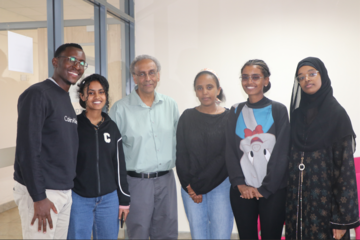
Several student success stories illustrate the long-term impact of the initiative. Hermela Gizaw, a member of the sepsis research group, secured an internship opportunity in Switzerland. Snit Teshome, from the LMS research group, received the Generation Google Scholarship, and Haymanot Alemayoh was admitted to the Development Engineering graduate program at the University of California, Berkeley. Woldesenbet Aregay from the modeling red blood cells group writes “My participation in the TI Analytics and the IMSS international conference enhanced my presentation, teamwork and research skills. These experiences helped me build confidence in communicating ideas and collaborating effectively within a team”. Woldesenbet secured an internship at iCog, Labs, an AI and Machine Learning research organization in Ethiopia. Bethlehem Getachew mentioned that the TI Analytics training enhanced her skills in applying data analytics to healthcare challenges, particularly through the pediatric sepsis project. She feels prepared to apply what she learned to projects in data science and cyber security analytics.
Particularly remarkable is that all these students are survivors of the recent civil conflict in their home country Ethiopia. Their achievements reflect resilience, determination, intellectual strength, and a commitment to overcoming adversity while contributing meaningfully to society.
While these students have benefited from support provided through the Mastercard Foundation at USIU-Africa to excel in academic accomplishments, they have also returned to their communities and engaged in service initiatives aimed at empowering young women to pursue STEM education. By sharing their experiences with younger students, they have emphasized the importance of confidence, independence, perseverance, and resilience, qualities they further strengthened through their participation in the TI Analytics program. Their stories demonstrate how research experiences can foster not only academic and professional growth but also leadership, mentorship, and broader community impact.
In conclusion, undergraduate research in mathematics is a transformative educational experience that significantly strengthens students’ intellectual and personal development. It cultivates critical thinking, creativity, resilience, communication skills, independence, and intellectual curiosity. Through research experiences, students move beyond passive learning to become active contributors to the creation and application of knowledge. They develop confidence in their abilities, learn to navigate challenges with persistence, and build habits of inquiry that support lifelong learning.
More importantly, undergraduate mathematical research prepares students not only for academic and professional success but also for meaningful engagement in society. By investing in undergraduate research opportunities, educational institutions create pathways for students to become innovative problem-solvers, thoughtful leaders, and intellectually empowered individuals equipped to address complex challenges and contribute positively to their communities and the broader world.
By:
Yasmine Ben Slimane
Wednesday, Jun 3, 2026



Leave a comment