


Yasmine Ben Slimane
(AAP)
Communications Coordinator
Communications
Business
Marketing
Transnational Student Collaboration: Driving Change Through Democratic Dialogue & Peacebuilding
When we began discussing the idea of a COIL dialogue project in early fall 2025 on peacebuilding and democracy in Mali and the U.S., we knew we had a lot in common in terms of our research and teaching, a significant amount of institutional support and social capital to build upon, and also many logistical obstacles to overcome. Our common interest in empowering students to become active participants in peacebuilding and democracy was reflected in the two courses we would be teaching in spring 2026. The limitations that the students would face in terms of time and internet connectivity would be significant, but hardly insurmountable. We also knew that the political world was changing very rapidly and so we may have to adjust the form and content of our collaboration to meet unexpected challenges.
All of this turned out to be very true. What also was true was the enthusiasm the students developed for the project and its success. This may seem like an odd thing to say about a peacebuilding and democracy project which over the past six months has encountered new levels of anti-democratic political violence in both Mali and the U.S. But rather than be discouraged, the students saw these obstacles as reasons for participating in this COIL project.
The centerpiece of our COIL project was a bi-weekly online discussion between four MSU students from a graduate seminar on democracy and 15 UYOB students in a course taught in English entitled American Civilization: What is history? The making of America. The texts were articles Niambélé, Esquith, Sheldon Wolin, and Achille Mbembe. These were critical – albeit in different ways. – of the relationship between economic power and democratic politics in both the U.S. and Mali. Our online discussions were complemented by participation by the UYOB students in an ongoing community engagement project in one of 10 camps for displaced persons in Mali. While the UYOB students were joining the concluding round of a photovoice project for youth in one of these IDP camps and then helping to plan the opening round of a political simulation, the Malian Peace Game, there, the MSU students were studying the potential value of artistic community engagement interventions such as these within dangerous conflict zones.
Our COIL project became a three-way collaboration between UYOB, MSU, and young people living in Mabile, a camp for internally displaced persons. Some of the online meetings combined the students from the two university classes with former UYOB students who had worked in the IDP camps as mentors since 2022 on the photovoice project and now served as senior mentors for the current UYOB students in the creation of the new peace game.
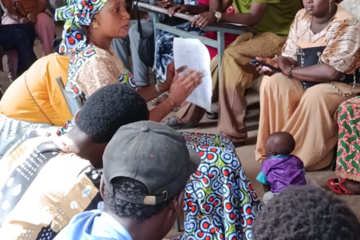
Hybrid (face-to-face and in-person) meetings in Bamako between MSU students, the new UYOB mentors, and the returning senior mentors, were conversations in both English and French. Three Team Leaders who had supervised the recently concluded photovoice exhibits in the IDP camps were joined by the two faculty instructors to facilitate these bilingual conversations to prepare the new (UYOB) and returning mentors for the peace game simulation.
Here is a picture of one such hybrid meeting held at the office of the International Sports Alliance in Bamako on a Sunday afternoon as the two groups of mentors prepared to launch the peace game and to discuss online the obstacles to peacebuilding and democracy with their MSU partners.Two weeks before the final COIL presentations and three weeks before the UYOB students visited Camp Mabile to meet their young mentees whom they would introduce to the peace game simulation, we asked these new mentors and their MSU COIL partners to reflect on the COIL project. Here is a small sample from those comments.
UYOB student (1): “This COIL project has been a bridge between Bamako and Michigan, allowing us to see that the challenges of democracy are universal. It has been an eye-opening experience to share our Malian perspectives with MSU students.”
UYOB student (2): “It has permitted me to know that democracy and politics are concepts that not only the leaders must know how they function, but the citizens, even those who are living in the very distant areas, also must know how they function: Tell them that the democracy and politics are part of their everyday life. Tell them that the way they organize meetings and ask the consent of all the community members to solve a collective problem of their community is also democracy, and tell them that democracy and politics simply mean the contribution of every single citizen to the betterment its community, country, continent, and the world in general because the more understanding they have on the rules and the different functions of democracy and politics the better society we have. This program has been an opportunity for me to understand the misunderstanding that exists between the representatives and the citizens: the representatives who supposed to act as servants to meet the need of those who they represent, once the power they become master who forbid any uttering from their subjects. Through the program, I have discovered that the young people are the main pillar of democracy and politics, and I also understand that my role goes beyond studying and working for my own interest: it is to be so active, to understand the rules and being able to explain them to those who do not have access to them.”
MSU student (1): "Participating in the COIL project has been an amazing opportunity. It has provided me with the space to discuss issues of global importance with folks whose perspectives I would never otherwise have heard. It has been immensely helpful for the ability of my colleagues and I to think through the crises of democracy as they are manifesting around the world, something that feels increasingly urgent in our current international political climate."
The final COIL presentations on Zoom on May 3, 2026, by UYOB and MSU students reflected the richness of the theory and practice of their study of and work on democratic peacebuilding within a zone of conflict, whether a low-income country like Mali or a higher income country like the U.S.
Limited internet connectivity made it difficult for all the participants to keep their cameras on for the whole meeting, and some participants had to connect via cell phones. Nevertheless, they were able to discuss the limits that aspiring democratic societies face and whether the state in these societies may ever threaten the life of persons within its borders, including those considered to be full citizens. This was followed by a discussion of the relationship between a democratic society’s commitment to majority rule its terms of membership. These theoretical questions were discussed and debated in the contexts of Mali and the U.S. where violence against displaced persons, immigrants, refugees, and legal citizens is part of the everyday reality of many persons.
By:
Yasmine Ben Slimane
Wednesday, Jun 3, 2026
YOUTH EMPOWERMENT
+1
Leave a comment
Student Development: Transforming Futures Through Mathematical Research
Undergraduate research in mathematics has one of its profound impacts on the development of students’ critical thinking skills. Traditional mathematics education often emphasizes solving well-defined problems with known methods. Research, however, presents open-ended questions where the solution is uncertain and the path forward is unclear. Students are required to analyze patterns, test hypotheses, and create logical arguments. This process strengthens their reasoning abilities and teaches them how to approach complex challenges systematically. As students engage deeply with mathematical problems, they learn not only to find answers but also to question assumptions, evaluate evidence, and refine their thinking. These intellectual habits are valuable in every aspect of life, including science, technology, business, and public decision-making.
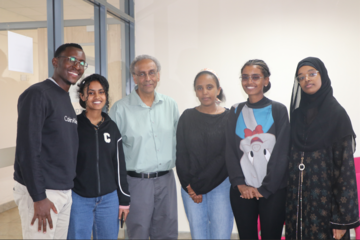
Guided by these underlying principles, a pilot initiative was launched in Spring 2025 at United States International University-Africa. The TI-Analytics Program was a four-week intensive undergraduate research experience that engaged twenty-one undergraduate students from USIU-Africa, including eleven female and ten male participants. The program was supported through a Transforming Institutions (TI) grant from the Alliance for African Partnership.
Four faculty members served as research mentors: Aklilu Zeleke from Michigan State University, alongside Gabriel Okello, Leah Mutanu, and Verrah Otiende from USIU-Africa. Prior to the launch of the program, the faculty mentors held regular planning meetings to design the day-to-day activities, establish student selection criteria, and identify appropriate research topics.
The twenty-one participants were selected based on their academic performance, demonstrated work ethic as reflected by faculty recommendations, and their interest in using research to address pressing challenges facing Africa. For many of the students, this was their first experience working on open-ended research projects in which the outcomes were unknown. To encourage independence and innovation, the faculty mentors intentionally provided minimal direction, allowing students to explore ideas creatively and shape the direction of their research.
All research groups conducted literature reviews relevant to their projects. Some teams modified existing mathematical models to create authentic research experiences, such as the dynamical systems group. Others applied existing models using different algorithms and analytical tools to compare their findings with established results, including the recommender systems and sepsis research groups. Another team worked with a unique institutional dataset to develop recommendations for assessing student performance through the Learning Management System (LMS). Undergraduate researchers participated in applied projects that required advanced mathematical, statistical, and computational techniques. Four research groups were formed, each guided by a faculty mentor. The projects focused on modeling the life cycle of red blood cells using dynamical systems, analyzing recommender systems for the aviation industry that generate booking options for airline passengers, applying analytical methods for the early prediction of pediatric sepsis-related mortality, and investigating student academic performance using data from the Blackboard Learning Management System (LMS).
The groups worked intensively from 9:00 a.m. to 5:00 p.m. each day for four weeks, with a half-hour mid-morning break and a one-hour lunch period. At the conclusion of the program, each group delivered a research presentation to invited guests from USIU and Mt. Kenya University, including college deans, faculty members, graduate students, and fellow undergraduate students.
Student engagement extended beyond the formal program period. For example, the group studying red blood cell life cycle modeling continued refining its work by incorporating advanced concepts from dynamical systems, including Lorenz attractors. The group later presented its enhanced findings at the 4th International Mathematics and Statistics Student Research Symposium.
Overall, student researchers expressed strong enthusiasm for participating in the pilot TI Analytics initiative and emphasized the value of integrating research experiences into undergraduate education. Faculty mentors further advanced the initiative by securing an AAP grant to support a yearlong program that will embed similar research experiences into existing mathematics and statistics courses at USIU during the 2026–2027 academic year.
Finally, we would like to highlight some of the program’s most significant impacts on individual student participants. One of the direct outcomes of the TI Analytics program was the development of strong mentoring relationships between faculty mentors and student researchers. These relationships extended beyond the program itself, with faculty mentors helping students identify and pursue additional research, internship, and educational opportunities both within Africa and internationally. For example, Dr. Aklilu Zeleke has continued to support participating students by providing mentorship and writing recommendation letters for academic programs and professional opportunities.
Several student success stories illustrate the long-term impact of the initiative. Hermela Gizaw, a member of the sepsis research group, secured an internship opportunity in Switzerland. Snit Teshome, from the LMS research group, received the Generation Google Scholarship, and Haymanot Alemayoh was admitted to the Development Engineering graduate program at the University of California, Berkeley. Woldesenbet Aregay from the modeling red blood cells group writes “My participation in the TI Analytics and the IMSS international conference enhanced my presentation, teamwork and research skills. These experiences helped me build confidence in communicating ideas and collaborating effectively within a team”. Woldesenbet secured an internship at iCog, Labs, an AI and Machine Learning research organization in Ethiopia. Bethlehem Getachew mentioned that the TI Analytics training enhanced her skills in applying data analytics to healthcare challenges, particularly through the pediatric sepsis project. She feels prepared to apply what she learned to projects in data science and cyber security analytics.
Particularly remarkable is that all these students are survivors of the recent civil conflict in their home country Ethiopia. Their achievements reflect resilience, determination, intellectual strength, and a commitment to overcoming adversity while contributing meaningfully to society.
While these students have benefited from support provided through the Mastercard Foundation at USIU-Africa to excel in academic accomplishments, they have also returned to their communities and engaged in service initiatives aimed at empowering young women to pursue STEM education. By sharing their experiences with younger students, they have emphasized the importance of confidence, independence, perseverance, and resilience, qualities they further strengthened through their participation in the TI Analytics program. Their stories demonstrate how research experiences can foster not only academic and professional growth but also leadership, mentorship, and broader community impact.
In conclusion, undergraduate research in mathematics is a transformative educational experience that significantly strengthens students’ intellectual and personal development. It cultivates critical thinking, creativity, resilience, communication skills, independence, and intellectual curiosity. Through research experiences, students move beyond passive learning to become active contributors to the creation and application of knowledge. They develop confidence in their abilities, learn to navigate challenges with persistence, and build habits of inquiry that support lifelong learning.
More importantly, undergraduate mathematical research prepares students not only for academic and professional success but also for meaningful engagement in society. By investing in undergraduate research opportunities, educational institutions create pathways for students to become innovative problem-solvers, thoughtful leaders, and intellectually empowered individuals equipped to address complex challenges and contribute positively to their communities and the broader world.
By:
Yasmine Ben Slimane
Wednesday, Jun 3, 2026
YOUTH EMPOWERMENT
+1

Leave a comment